I used to wear my sleep deprivation like a badge.
Five hours a night during a heavy project. A 4am alarm as proof of commitment. The quiet pride of being the person in the room who needed the least recovery. It felt like discipline. The research says it was something closer to self-sabotage.
Everything the brain needs to do to make tomorrow’s work possible happens while you sleep. Sleep is not where the day ends. It is where the next day is built.
TL;DR / Key Takeaways
- Sleep is not recovery from work. It is the biological process that makes work possible. Memory consolidation, emotional regulation, executive function, and brain waste clearance all depend on it.
- A 2025 review confirmed that sleep deprivation impairs the prefrontal cortex specifically, producing measurable deficits in decision-making, impulse control, and cognitive flexibility.
- The brain runs a dedicated waste clearance system almost exclusively during deep sleep. Chronic sleep deprivation means chronic accumulation of the proteins most closely linked to Alzheimer’s disease.
What does the brain do while you sleep?
The brain does not go offline when you sleep. It switches shifts.
The daytime shift acquires information, makes decisions, navigates the social and physical world. It is loud, directed, and visible. The night shift is quieter but equally essential, and the work it does cannot be replicated, accelerated, or substituted by anything that happens during waking hours.
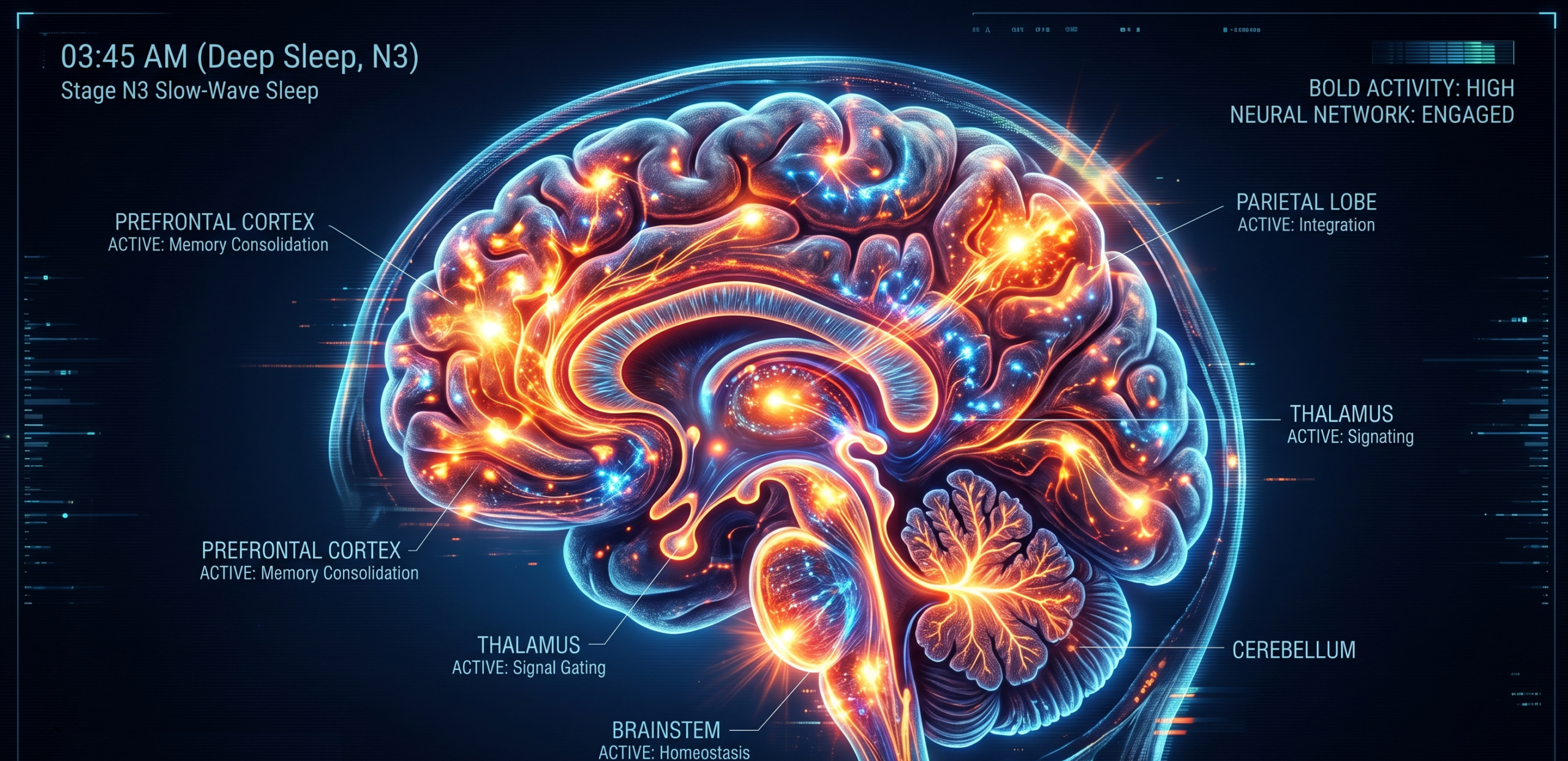
Memory consolidation is the first function. During NREM sleep, the brain replays neural activation patterns from the day’s learning, transferring them from short-term hippocampal storage into long-term neocortical memory. The information you worked to acquire today is not fully yours until you sleep. What looks like forgetting when you skip sleep is not a retrieval failure. It is a consolidation failure. The transfer never completed.
During REM sleep, a different process runs. Emotionally significant memories are processed and integrated. The amygdala, which flags emotional threat and intensity, is recalibrated. REM sleep modulates the emotional charge of negative experiences, not erasing them, but reducing their raw intensity so they can be held without being destabilizing. Without adequate REM, the amygdala becomes hyperreactive. The world feels more threatening. Provocations feel more severe. Other people feel more difficult.
The prefrontal cortex is the third piece. It governs working memory, impulse control, executive function, and the capacity to evaluate consequences before acting. It is also among the most sleep-sensitive regions in the brain. A 2025 narrative review in Cureus, synthesizing current research across cognitive, affective, and behavioral outcomes, confirmed that sleep deprivation weakens prefrontal-amygdala connectivity directly, producing emotional dysregulation, increased risk-taking, and impaired decision-making. Critically, sleep-deprived people are largely unaware of the degree of their own impairment. The review is published in The Role of Sleep and the Effects of Sleep Loss on Cognitive, Affective, and Behavioral Processes, Cureus 2025.
The night shift is not optional infrastructure. It is the infrastructure. Everything else depends on it running properly.
What is the glymphatic system?
There is a second system operating during sleep that most people have never heard of. It is called the glymphatic system.
Named after glial cells and the lymphatic system, it is the brain’s dedicated waste clearance mechanism. During deep NREM sleep, the brain’s interstitial space expands by up to 60%, allowing cerebrospinal fluid to flush through brain tissue and clear out metabolic waste products. The primary waste being cleared includes amyloid beta and tau proteins, the same proteins that accumulate in the brains of Alzheimer’s patients.
In plain terms: every night of adequate deep sleep is a biological cleaning cycle for the brain. Every night of insufficient sleep is a missed cycle. Over years and decades, the accumulation builds. Research published in April 2025 from the Medical University of Innsbruck examined this mechanism and its long-term neurological implications in detail, available in Sleep as the Foundation of Brain Health, Medical University of Innsbruck.
Think of it this way. An operating theater used all day with no overnight cleaning still works the next morning. The equipment functions. The surfaces look normal. But the invisible accumulation of biological material builds up steadily, and over time it creates conditions for failure that a daily cleaning would have prevented. The glymphatic system is the cleaning crew. Deep sleep is the window in which they can actually operate. Without the window, the cleaning does not happen.
This is why chronic sleep deprivation is not just a productivity problem. It is a long-term neurological risk factor. Not immediately. Not dramatically. Gradually, invisibly, and cumulatively.
The Sleep Infrastructure Protocol
Most sleep advice focuses on bedtime habits. The research points somewhere else.
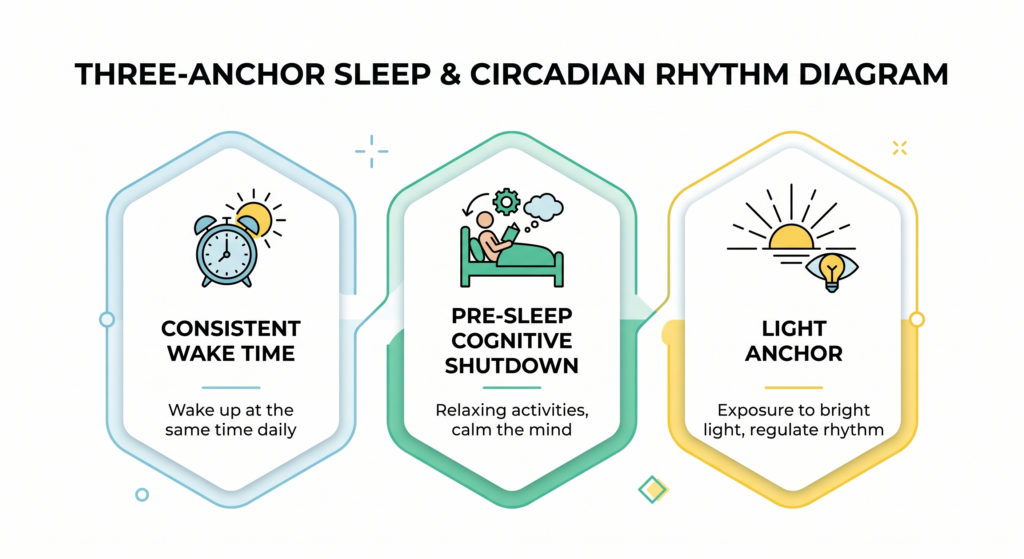
Sleep quality is determined less by what you do in the hour before bed and more by the structural architecture you maintain across the entire day. Three anchors. Not a checklist. The three variables that have the most consistent and measurable impact on sleep quality and cognitive outcome.
Anchor 1: The Consistent Wake Time. Not bedtime. Wake time. The body’s circadian rhythm is anchored to light and the time of waking, not the time of sleeping. A consistent wake time, including weekends, stabilizes the entire sleep architecture downstream. Irregular wake times disrupt sleep staging, reduce deep NREM, and impair both the memory consolidation and glymphatic clearing that depend on it. This single variable has more use over sleep quality than almost anything else you can change. Pick a wake time and hold it.
Anchor 2: The Pre-Sleep Cognitive Shutdown. The brain cannot transition from operational mode to recovery mode without a deliberate signal that the operational day is finished. The 30 to 60 minutes before bed should be cognitively quiet: no screens delivering new information, no unresolved decisions being rehearsed, no stimulating content loading new material into working memory. The Loop Capture protocol from the April 30 post, externalizing open tasks before the day ends, is the tool. The principle is simple. Close the open tabs before the system needs to enter maintenance mode. It cannot do both simultaneously.
Anchor 3: The Light Anchor. Morning light exposure within the first 30 minutes of waking sets the circadian clock for the entire day. Bright natural light signals the brain that the active cycle has begun and starts a countdown to melatonin release roughly 14 to 16 hours later. This is the most underused sleep intervention available and it costs nothing. Ten minutes outside in the morning light affects the quality of sleep that night more than most supplements, devices, or routines combined.
Before you move on from this post: what time did you wake up this week? Was it the same time every day? If not, the rest of your sleep architecture is building on an unstable foundation regardless of what else you are doing.
The Application
A well-ordered mind is not built during the day. It is maintained at night.
The quality of your thinking, your emotional responses, your decisions, and your long-term cognitive health are all downstream of what happens during the hours most people treat as the least productive part of their schedule.
Sleep is not where productivity pauses. It is where it becomes possible.
Treat the night shift accordingly.