“You could leave life right now. Let that determine what you do and say and think.”
Marcus Aurelius wrote that in a private journal. He never intended anyone else to read it. He was the Emperor of Rome, commander of legions, the most powerful person in the ancient world, and he sat down every day and reminded himself that he was going to die.
Not as a morbid exercise. As a precision instrument.
That distinction is the entire point.
TL;DR / Key Takeaways
- Marcus Aurelius ended each day by reminding himself he could leave life at any moment. Not as a morbid exercise, as a tool for eliminating distraction and clarifying what actually matters.
- Modern psychology confirms what the Stoics understood intuitively: deliberate mortality awareness encourages meaningful action and authentic living. Accidental mortality awareness produces anxiety.
- This week’s calibration: the Deathbed Filter, one question applied to your current priorities before the week begins.
What is Memento Mori?
In ancient Rome, when a general returned victorious from war, the city celebrated with a triumph. The spectacle was enormous. Crowds lining the streets. Legions marching. The spoils of conquered lands on display. The general rode at the center of it all, at the absolute pinnacle of Roman power and glory.
Behind him in the chariot stood a slave. That slave had one job. To whisper into the general’s ear, throughout the entire parade, four words: Memento mori. Remember you must die.
This was not cruelty. It was structural design. The Romans understood that success without a mortality filter produces arrogance, complacency, and the squandering of everything that was earned. The reminder was the check on all of it. Power needed a counterweight. The counterweight was finitude.
Marcus Aurelius took this further than anyone. He did not wait for a slave or a ceremony. He built the practice into his daily private writing. The Meditations were never meant to be read by anyone else. They were a personal record of a man, who ruled an empire, managed armies, and navigated the most complex political environment in the ancient world, reminding himself every single day that none of it was permanent.
The full philosophical and historical context is examined in Memento Mori: From the Guise of the Ancients to 21st Century Practice, Modern Stoicism.
Most people today only encounter mortality awareness when it is forced on them. A diagnosis. A loss. A close call on the highway. At that point the confrontation with death arrives as a shock rather than a tool. Research on Terror Management Theory confirms the difference in outcome: when mortality awareness arrives suddenly and unprepared, the response is defensive, anxiety, distraction, and the pursuit of trivial status signals. When it arrives deliberately and practiced, the response is the opposite: a turn toward what is genuinely meaningful. The Stoics used it daily precisely because they understood this distinction. The practice was not about dwelling on death. It was about training the mind to respond to finitude with clarity rather than panic.
How does Memento Mori help you set priorities?
Here is the practical function of Memento Mori. It is not emotional. It is editorial.
Most people operate with an inflated sense of available time. Because tomorrow exists in the abstract, almost everything feels deferrable. The difficult conversation. The meaningful project. The relationship that needs attention. The creative work that keeps getting pushed. All of it gets displaced by things that feel urgent but are not important. The inbox. The meeting that should have been an email. The noise that fills the available space because the available space has no filter on it.
Memento Mori is the filter.
Think of it this way. When you think you have unlimited luggage, you pack everything. Every “maybe” item, every just-in-case layer, every thing you might need. When you know the bag is a carry-on with a fixed capacity, every item gets evaluated. Is this worth the space? Does this deserve to come with me? The edit that an unlimited timeline never produces happens naturally when the constraint is real.
The mortality filter produces the same edit. Suddenly the list of what actually matters becomes very short. The things you have been avoiding because they are difficult rise to the top. The things you have been doing out of habit or obligation fall away. The constraint is clarifying in a way that comfort never is.
University of Pennsylvania research on mortality awareness and vitality, published in Memento Mori: Reflecting on Mortality to Inspire Vitality, supports what Marcus Aurelius understood from practice: confronting finitude deliberately produces not despair but direction.
This Week’s Protocol: The Deathbed Filter
Every Sunday Calibration ends with one practice to carry into the week.
This week it is the Deathbed Filter. One question. Applied deliberately to the things on your plate before the week begins.
“If I were looking back at this moment from the end of my life, would this have mattered?”
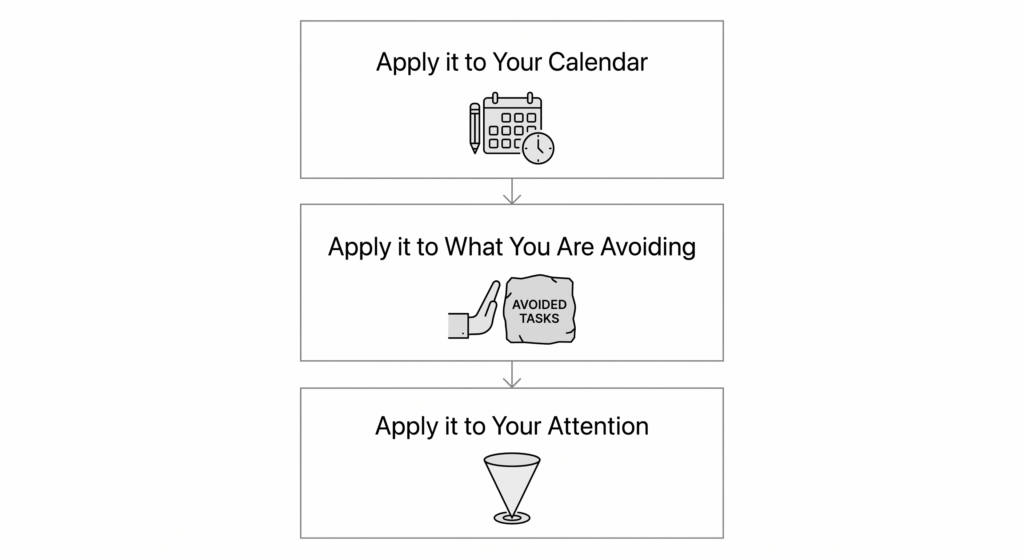
That question is not designed to make everything feel meaningless. It is designed to reveal what is actually meaningful versus what only feels urgent because of proximity and noise. Apply it three ways this week.
Apply it to your calendar. Look at what you have scheduled this week. Which of it would survive the filter? Which of it is noise dressed as obligation? You do not need to clear the calendar. You need to know which items deserve your full weight and which deserve the minimum necessary.
Apply it to what you are avoiding. The conversation you keep deferring. The decision you keep putting down. The work that matters but keeps getting displaced by work that merely feels pressing. Does it pass the filter? If it does, it moves to the front of the week. Not eventually. This week.
Apply it to your attention. Not your time, your attention. Where is your mind actually going when it is not being directed? What are you consuming, rehearsing, and spending cognitive energy on? Would that survive the filter? If not, what does it cost you to keep running it?
Marcus Aurelius was the most powerful person in the ancient world. He still needed the daily reminder. Not because he was weak but because he understood how the mind works without it. Left to its own defaults, the mind fills available time with available noise. The filter is not a sign of fragility. It is a sign of clarity about what the mind requires to stay oriented toward what matters.
You could leave life right now.
Let that determine what you do with this week.