
Most people have a financial behavior they cannot explain.
The person who earns well and never seems to have anything saved. The person who spends aggressively the moment money arrives, as though holding it creates pressure. The person who ties their self-worth directly to their net worth and feels like a failure every time the numbers dip. The person who avoids checking their accounts entirely, for weeks at a time, as though not looking changes what is there.
These are not personality quirks. They are not discipline failures. They are scripts. And most of them were written before you were ten years old.
TL;DR / Key Takeaways
- Financial psychologists Klontz and Klontz identified four money scripts, subconscious beliefs about money formed in childhood, that directly predict adult financial behavior: Money Avoidance, Money Worship, Money Status, and Money Vigilance.
- Money scripts are typically unconscious, passed down through family systems, and formed through emotionally charged financial experiences in childhood called financial flashpoints.
- You cannot change a financial behavior you do not understand. This post is about understanding the script running underneath yours.
The Four Scripts
In 2011, financial psychologists Ted Klontz and Brad Klontz published research that changed how therapists and financial planners understand money behavior.
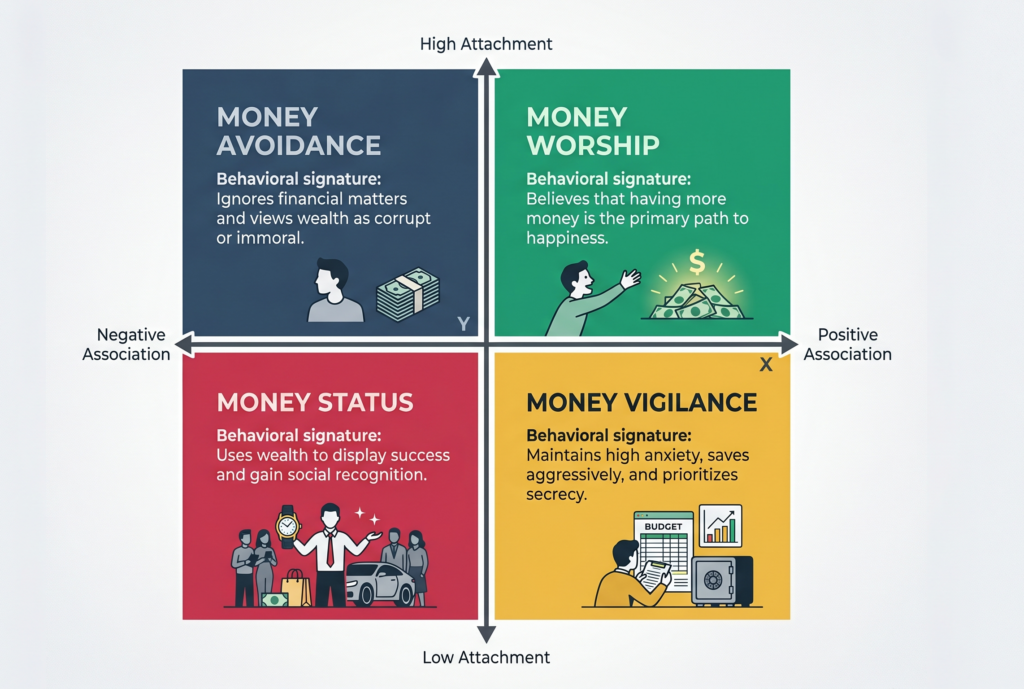
They identified four distinct patterns of subconscious money belief, what they called money scripts, that operate below conscious awareness, form in childhood, pass down through family systems, and directly predict adult financial behavior. Not tendencies. Predictors. The scripts are so consistent in their behavioral signatures that trained practitioners can identify which one a person is running by watching how they behave with money, often before the person can name it themselves.
The research is detailed in the Journal of Financial Therapy and summarized in Money Scripts: Understanding Your Relationship With Money, FinMasters.
Here are the four.
Money Avoidance. The belief that money is bad, corrupting, or something you do not deserve. People running this script often sabotage their own financial progress in ways they cannot explain: avoiding bank statements, under-earning relative to their actual capability, giving money away compulsively before it can accumulate, or feeling genuine guilt when they experience financial success. The script sounds like: “Money changes people.” “Rich people are greedy.” “I do not need much.” The avoidance feels like virtue. It is usually a belief formed around witnessing what money did to people in early life.
Money Worship. The belief that more money will solve everything, that happiness, security, and worth are always just one income level away. People running this script work compulsively, accumulate without satisfaction, and experience a persistent gap between what they have and what they believe they need. The script sounds like: “If I just had more, everything would be fine.” The irony is precise. The worship produces the earning. The satisfaction never arrives. Because the script is not really about money. It is about safety. And no amount of money makes the script feel safe enough.
Money Status. The belief that net worth equals self-worth. Financial position becomes identity. People running this script overspend to signal success, feel deep shame about financial struggles, and make decisions based on how they will appear rather than what actually serves them. The script sounds like: “What people see of my finances is who I am.” It produces the appearance of financial health and the reality of financial fragility, often simultaneously.
Money Vigilance. The belief that financial security requires constant watchfulness and that money should never be discussed or displayed. People running this script are strong savers but struggle to enjoy what they have built, feel persistent anxiety regardless of their actual financial position, and often cannot bring themselves to spend even when it would genuinely improve their quality of life. The script sounds like: “You can never be too careful.” “Never let people know what you have.”
Money Vigilance is worth noting separately. It is the only script with partially protective effects. It correlates with better savings behavior and lower debt. But in excess it produces financial paralysis: the inability to enjoy the security that has been painstakingly built. The savings accumulate. The anxiety does not decrease.
The Financial Flashpoint
Scripts do not appear from nowhere. Klontz and Klontz identified the primary formation mechanism: what they called financial flashpoints.
Financial flashpoints are emotionally charged money-related experiences in childhood that leave lasting cognitive imprints. The child’s mind, trying to make sense of what it is observing, forms a rule. That rule becomes the script. And the rule made complete sense in the context in which it was formed. It may make no sense in the adult life the person is now living.
These are not always dramatic events. A parent’s offhand comment about money overheard at age seven. Watching parents argue about finances repeatedly and learning that money equals conflict. Growing up in a household where financial struggle was constant but never acknowledged. Experiencing a period of instability that resolved but left its mark. Being raised in a family that appeared financially comfortable but was privately in debt.
The child does not analyze the experience. The child concludes from it. And the conclusion becomes the operating belief.
A 2025 study published in the Journal of Financial Therapy confirmed that family financial socialization remains the dominant predictor of money script formation across all life stages, childhood, high school, college, and adulthood. The full study is available at Financial Socialization and Money Scripts, Journal of Financial Therapy 2025. The scripts formed before age ten are still running at age forty. They do not update automatically with new information or life experience. They require deliberate examination.
Think of it this way. Imagine being handed a map of a city as a child and navigating by it for thirty years without checking whether the roads have changed. The map was accurate when it was drawn. The city has been rebuilt several times since. But the navigation continues based on the original cartography. Money scripts are the map. Most people are still driving by childhood directions.
The Script Audit
Direct introspection is unreliable for identifying money scripts because the scripts operate below conscious awareness. Asking yourself what you believe about money produces the answer you think is true, not necessarily the answer that is actually running. The behavioral examination is more accurate.
Three questions. Each surfaces the script through what you actually do rather than what you think you believe.
Question 1: What do you do with money when you are not thinking about it? Not what you intend to do. What actually happens. Do savings accumulate or disappear without clear reason? Do you avoid looking at your accounts or check them compulsively? Do you spend freely the moment money arrives or freeze at every discretionary purchase? The automatic behavior is the script expressing itself without interference.
Question 2: What did money mean in the house you grew up in? Not what was said about money, what was demonstrated. Was it a source of tension or a source of security? Was it discussed openly or treated as taboo? Was it something to be pursued aggressively or something to be feared? Was financial struggle visible or hidden? The environment formed the belief before you had language to examine it.
Question 3: What financial behavior do you know you should change but consistently do not? The gap between what you know and what you do is almost always a script. Knowledge does not override belief. The behavior that persists despite your better judgment and your genuine intention to change it is the script operating at full strength. That is the one to examine.
The audit does not change the script. It names it. And naming it is the precondition for everything that follows. You cannot examine a belief you do not know you hold. You cannot change a behavior whose source you have never identified.
The Application
Beautiful thinking requires honest thinking. And nowhere is honest thinking harder than in the domain of money, where the beliefs run deepest, the flashpoints hit earliest, and the scripts are most thoroughly mistaken for facts.
The money scripts running underneath your financial life are not moral failures. They are cognitive artifacts of a childhood environment you did not choose. Examining them is not self-criticism. It is the intellectual honesty required to see what is actually driving the behavior you cannot seem to change.
This is Part 2 of the financial psychology thread. Part 1 covered what financial anxiety costs cognitively. Part 3 will address the operating system underneath both: how scarcity thinking works as a cognitive mode and what replaces it.
Name the script first. Everything else follows from that.