

I have been told to breathe more times than I can count.
In tense meetings. Before difficult conversations. After receiving news I was not ready for. The advice arrived well-meaning and consistently useless because nobody ever explained what breathing actually does or gave me a specific tool for the specific moment I was in.
So I dismissed it the way most people do. It felt like the kind of advice given when there was nothing better to offer.
The research says that was a mistake. Breath is not a soft coping suggestion. It is a direct physiological lever for cognitive and emotional state, and it operates faster than any other regulation tool available.
TL;DR / Key Takeaways
- A Stanford randomized controlled trial found that five minutes of daily cyclic sighing produced greater improvements in mood and greater reductions in physiological arousal than five minutes of mindfulness meditation over 28 days.
- The vagus nerve, which governs the transition between stress and calm, is directly accessible through breath. Extended exhalation specifically activates it.
- Three specific tools for three specific states: the physiological sigh for acute stress, box breathing for sustained focus, extended exhale for pre-sleep wind-down.
How does breathing calm the nervous system?
Most tools for managing emotional and cognitive state work indirectly.
Therapy changes thought patterns over months. Exercise releases neurochemicals after sustained effort. Medication adjusts baseline chemistry across weeks. All of these are valuable. None of them work in the next 90 seconds.
Breath is different. It is the only autonomic function that can be overridden by conscious control. Heart rate, digestion, immune response, none of these are accessible through voluntary action. Breath is. And because breath is directly connected to the nervous system through the vagus nerve, controlling the breath controls the state.
The vagus nerve is the longest cranial nerve in the body. It runs from the brainstem through the heart, lungs, and digestive tract, connecting the brain to the body’s major organ systems. It is the primary conductor of the parasympathetic nervous system, the “rest and digest” system that counteracts the fight-or-flight stress response.
When you extend the exhale, mechanical receptors in the lungs send signals through the vagus nerve that increase vagal tone and activate the parasympathetic system. Heart rate slows. Cortisol drops. The prefrontal cortex, which goes partially offline during acute stress, comes back online. You do not have to wait for the stress to pass. You activate the physiological conditions for it to pass.
A 2025 comprehensive review in Medical Sciences confirmed that vagus nerve involvement is the unifying physiological pathway behind the benefits of multiple breathwork techniques. The mechanism is consistent across methods. The delivery varies. The result is the same. The full review is published in Breathwork for Chronic Stress and Mental Health, Medical Sciences 2025.
Does breathwork beat mindfulness meditation?
In 2023, researchers at Stanford published what remains the most rigorous head-to-head comparison of breathwork versus mindfulness meditation to date.
114 participants. 28 days. Five minutes of daily practice. Four groups: cyclic sighing, box breathing, cyclic hyperventilation, and mindfulness meditation. All four groups showed improvements in mood and reductions in anxiety over the study period. But cyclic sighing produced the greatest improvements in both mood and physiological arousal of any group tested, including the mindfulness group. Daily positive affect increased by 1.91 points for breathwork versus 1.22 for mindfulness.
The finding that matters most for practical application: breathwork outperformed mindfulness specifically for real-time, in-the-moment stress relief. Mindfulness produced benefits that accumulated over time. Breathwork produced benefits that were measurable immediately after each session.
This distinction is important. Mindfulness is a long-term practice that builds a relationship with your mental states over weeks and months. Breathwork is a tool you reach for in the moment, before the meeting, after the difficult conversation, in the 90 seconds before you need to perform. Both have value. They operate on entirely different timescales. The full study is published in Brief Structured Respiration Practices Enhance Mood and Reduce Physiological Arousal, Cell Reports Medicine.
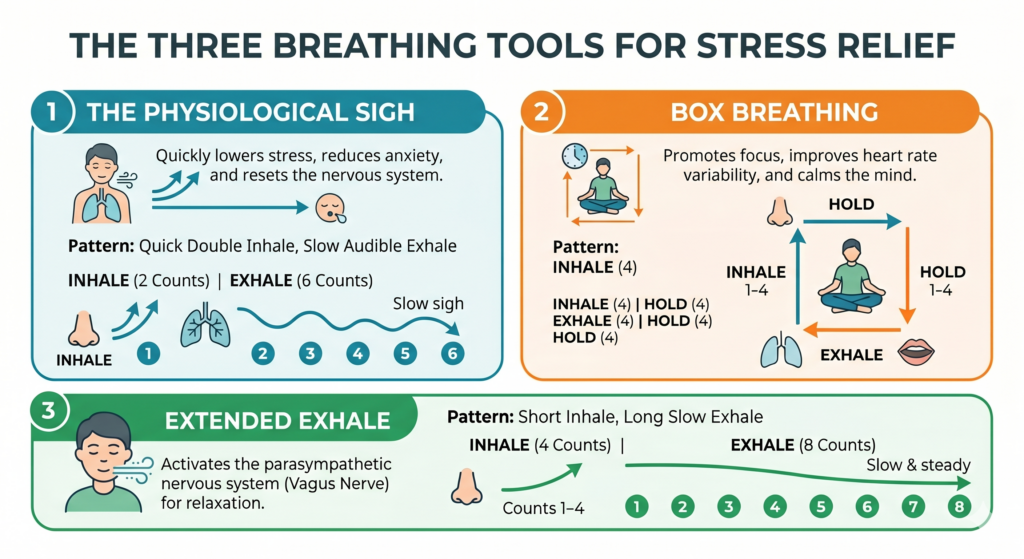
The Three-Tool Protocol
Three specific breathing patterns for three specific states. Not a general recommendation to breathe more slowly. Tools matched to situations.
Tool 1: The Physiological Sigh (acute stress). Two inhales through the nose followed by a long, slow exhale through the mouth. The first inhale fills the lungs. The second shorter inhale, stacked on top, maximally inflates the alveoli and allows maximum CO2 offload on the exhale. This is the pattern the body produces naturally under prolonged stress. The involuntary sigh is not a sign of distress. It is the nervous system self-regulating.
The Stanford study found cyclic sighing to be the single most effective technique for immediate reduction in physiological arousal of all techniques tested. Use it before a high-stakes conversation, in the moment of acute frustration, or when the stress response has been triggered and you need to come back online fast. One to three cycles is sufficient for a measurable shift. It takes less than 30 seconds.
Tool 2: Box Breathing (sustained focus). Four counts in through the nose, four counts hold, four counts out through the mouth, four counts hold. Repeat for four to six cycles. This pattern produces calm alertness rather than relaxation. It was developed and used by Navy SEALs for performance under pressure, not to reduce arousal to zero but to stabilize it at a level where clear thinking and precise execution are possible.
Use it before a presentation, before a significant decision, or at the start of a deep work block. The goal is not calm. It is regulated. There is a difference. Calm is passive. Regulated is operational.
Tool 3: Extended Exhale (pre-sleep wind-down). Inhale for four counts, exhale for eight. The extended exhale, twice the length of the inhale, maximally activates vagal tone and shifts the nervous system decisively into parasympathetic mode. This is the pattern to use in the final ten minutes before sleep, after the Cognitive Shutdown Protocol from the April 30 post has been completed. It supports the physiological transition from operational mode to recovery mode that the shutdown protocol initiates cognitively.
Before you move on: pick one of the three tools. Not all three. The one that matches the state you most commonly need to shift out of this week. Use it once today. One session. Notice what changes.
The Application
A well-ordered mind requires a regulated nervous system as its foundation.
You cannot think clearly, decide well, or show up fully from a dysregulated state. The breathwork practices in this post are not a soft add-on to the cognitive and philosophical work in this series. They are the physiological prerequisite for it. The Ataraxia from Sunday’s calibration, the focused attention from Prosoche, the clear judgment the cardinal virtues require, all of it depends on a nervous system that is not in override mode.
The tool is already installed. It requires no equipment, no subscription, and no training beyond what you have just read.
Use it.













You must be logged in to post a comment Login