“When you relax your attention for a while, do not fancy you will recover it whenever you please; but remember this, that because of your fault of today your affairs must necessarily be in a worse condition on future occasions.”
Epictetus wrote that in the Discourses. It is not a gentle invitation to breathe deeply and observe your thoughts without judgment.
It is a warning.
The Stoics had a word for the practice of attention: Prosoche. It is often compared to mindfulness. That comparison is accurate in the way that a scalpel and a butter knife are both cutting tools. The surface similarity obscures a fundamental difference, and that difference is the entire point of this calibration.
TL;DR / Key Takeaways
- Prosoche, the Stoic practice of attention, is often compared to mindfulness but is fundamentally different. Modern mindfulness is receptive and non-judgmental. Prosoche is active and morally directive.
- Pierre Hadot called it “the fundamental Stoic spiritual attitude,” a continuous state of vigilance over your thoughts, judgments, and actions to ensure they align with your values.
- This week’s calibration: the Attention Audit, three questions run at the end of each day to check where your mind actually went.
What is Prosoche?
The word comes from the Greek proséchō: to attend to, to apply oneself, to hold toward.
Philosophically, the Stoics used Prosoche to mean a continuous state of attentiveness to your inner life. Not a session you schedule. Not a breathing exercise you complete and set aside. A way of moving through the day with your attention directed inward as much as outward, watching your own thoughts and judgments as they form in real time.
The Stoics considered Prosoche the foundation for everything else. Without it, all other philosophy collapses into theory. You can know that you should respond with equanimity. You can have memorized every relevant passage from Marcus Aurelius. Prosoche is what allows you to actually notice, in the moment, when you are failing to do so, and to correct course before the failure compounds into something larger.
Epictetus was explicit about the cost of lapses. Attention is not a skill you can turn on when needed and turn off safely the rest of the time. Every moment of drift carries a consequence. Every time the mind goes unconscious, it defaults to its oldest, least examined patterns. The practice is not about achieving perfection. Epictetus himself acknowledged that was not the goal. It is about not letting the mind go absent.
Marcus Aurelius approached it differently but arrived at the same place. Pierre Hadot described his method as “circumscribing the present”: narrowing attention to present thoughts, present impulses, present actions. Not the past, which cannot be changed. Not the future, which cannot be controlled. Only the present moment contains anything that can actually be worked with. The full examination of Prosoche as a practice is detailed in What is Prosoche? Examining the Stoic Meaning of Attention, Viastoica.
How is Prosoche different from mindfulness?
Here is where most people get this wrong, and it matters enough to be precise about.
Modern mindfulness, developed in the Kabat-Zinn tradition, is non-judgmental observation of present experience. You notice what is happening in your mind and body without evaluating it as good or bad. The thought arises. You observe it. You do not chase it or fight it. The practice produces calm, reduces stress, and builds present-moment awareness. It is genuinely valuable and well-supported by research.
Prosoche is not that.
Prosoche is not receptive. It is directive. It does not simply observe what is happening in the mind. It evaluates what it finds against a standard. Are this thought, this judgment, this impulse aligned with virtue and reason? If not, correct it. Now. The Stoics were not building observers of their mental weather. They were building people who could catch themselves mid-thought, mid-reaction, and choose differently in real time.
Philosopher Massimo Pigliucci, writing in the Routledge Handbook on the Philosophy of Meditation, argued that Prosoche bears only a superficial resemblance to mindfulness. The superficial similarity is attention. The difference is what you are meant to do with what attention reveals. His full analysis is covered in Prosoche as Stoic Mindfulness, New Work in Philosophy, Massimo Pigliucci.
Think of it this way. Modern mindfulness is a weather report. It tells you accurately what is happening in the atmosphere of your mind. Prosoche is air traffic control. It is not just observing the aircraft. It is actively directing them, correcting their course, and ensuring nothing dangerous gets through without scrutiny.
Both are practices of attention. They are aimed at entirely different outcomes.
This Week’s Protocol: The Attention Audit
Every Sunday Calibration ends with one practice to carry into the week.
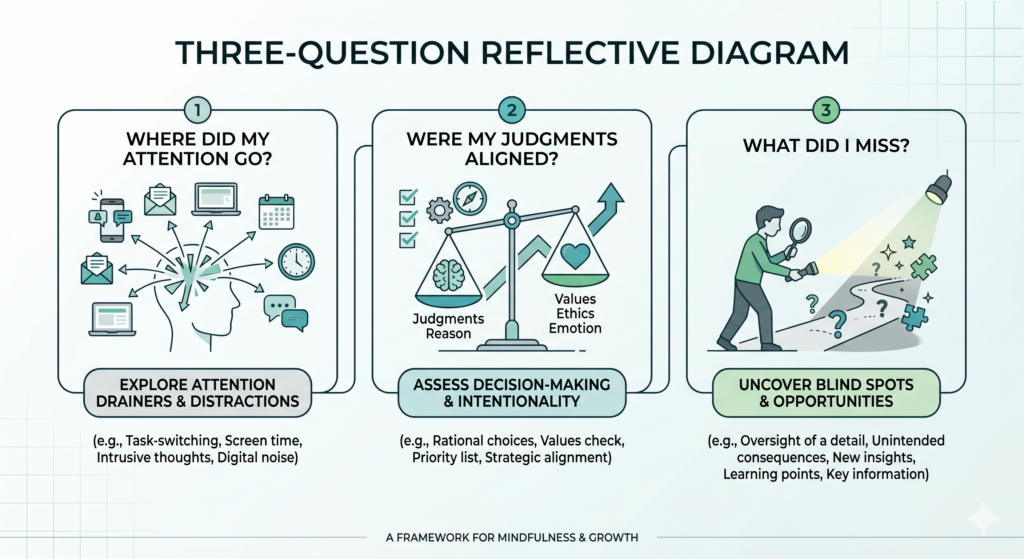
This week it is the Attention Audit. Three questions. Run at the end of each day. Not a meditation session. Not a journaling exercise. A brief, deliberate reckoning with where the mind actually went during the day. It takes five minutes. It is not designed to produce answers that feel good. It is designed to produce honest accounting.
Question 1: Where did my attention go that I did not choose? Identify the moments today when your mind drifted, was captured, or was pulled somewhere you would not have consciously directed it. The distraction you did not decide to engage. The rumination that ran without permission. The hour that passed without your awareness of how it was spent. Not to judge it. To see it clearly.
Question 2: Were my judgments today aligned with my values? This is the Prosoche question and it is the hardest one. Not just what you did but what you told yourself about what happened. Were you fair in your interpretations of other people? Were you honest with yourself about your own behavior and motivations? Where did your reasoning drift from the values you claim to hold? The Stoics were clear: the unexamined judgment is the source of almost all unnecessary suffering.
Question 3: What did I let pass without attention that deserved it? The conversation you were physically present for but mentally absent from. The decision you made on autopilot that deserved deliberate thought. The moment that mattered that went unnoticed because the mind was somewhere else. Prosoche is not only about catching what should not be there. It is also about catching what was worth attending to that drift caused you to miss.
The audit is the practice of Prosoche in its most accessible form. Run it for one week. Not to achieve anything in particular. To see, with more clarity than you currently have, where your mind is actually going when you are not watching.
The Application
Beautiful thinking is not passive.
It is not a state that descends on a calm mind after sufficient rest. It is the product of sustained, active attention directed toward the right things. Prosoche is the practice that makes beautiful thinking possible. Not the inspiration to think well, but the vigilance that keeps the mind oriented toward doing so consistently.
The undirected mind is not resting. It is drifting.
Run the audit. See where it went.