
“Some things are in our control and others not. Things in our control are opinion, pursuit, desire, aversion, and, in a word, whatever are our own actions. Things not in our control are body, property, reputation, command, and, in one word, whatever are not our own actions.”
, Epictetus, Enchiridion, Chapter 1
He wrote that nearly two thousand years ago.
It is still the most violated rule in modern life.
Not because people haven’t heard it. Most have, in some form. The problem is that hearing it and living by it are two entirely different things. One takes a few seconds. The other takes a lifetime of deliberate practice.
This week’s calibration is about that gap.
TL;DR / Key Takeaways
- The dichotomy of control is not a philosophy of passivity. It is a ruthless audit of where your energy is actually going.
- A study of over 2,000 participants found that practicing this principle correlates strongly with flourishing, life satisfaction, and emotional balance.
- This week’s calibration: identify what you are spending energy on that is not yours to control. Stop paying that tax.
What is the dichotomy of control?
Most people encounter the dichotomy of control as an abstract idea. Something to nod at in a philosophy class or underline in a book. That is the wrong application.
It is a sorting tool. Practical, immediate, and ruthless.
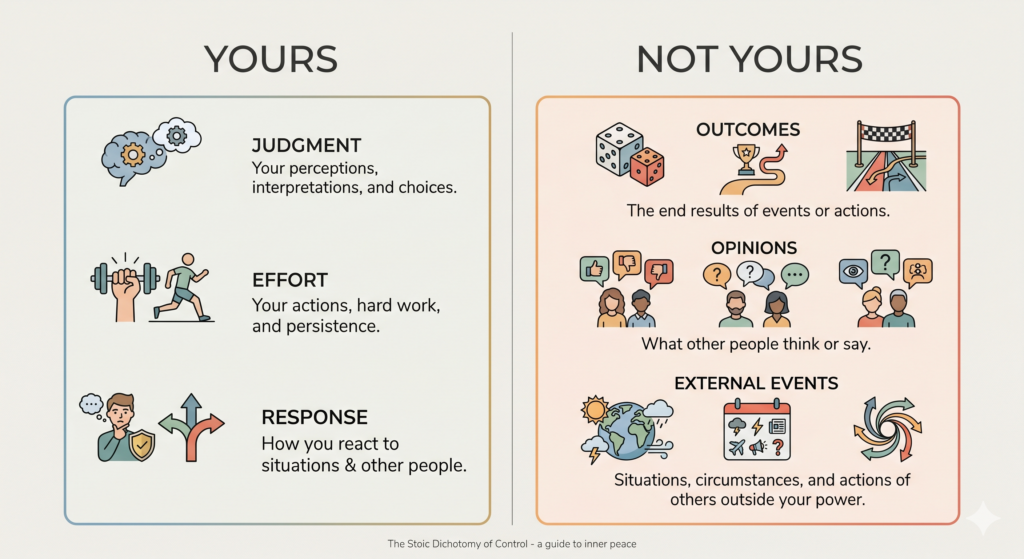
Everything in your life goes into one of two columns.
Column One: Yours. Your judgment. Your effort. Your response. Your values. Your attention. Your preparation. The spirit in which you show up. These belong to you entirely. They are, as Epictetus put it, free, unbounded, and unhindered by anything outside yourself.
Column Two: Not Yours. Other people’s opinions. The outcome of a conversation. The state of the economy. What your colleague says about you in a meeting you are not in. The news cycle. The result of a decision you have already made. These are not yours. They never were.
The problem is not that people don’t understand this in theory. The problem is where their energy actually goes.
Most people spend the majority of their time, attention, and emotional resources in Column Two. And Column One, the only column they can actually do anything with, sits largely unattended.
Think of your attention as a currency. Column Two is a slot machine. You keep feeding it coins expecting a payout that is structurally impossible. Meanwhile Column One, the investment account with guaranteed returns, sits untouched.
Research from a study of over 2,000 participants during Stoic Week found that practicing the dichotomy of control showed significant positive correlation with flourishing, life satisfaction, and emotional balance. Controlling the controllables specifically correlated at .51 with flourishing, one of the strongest findings in the study. The full breakdown is covered in The Stoic Dichotomy of Control in Practice, Psychology Today.
This is not ancient wisdom dressed up as self-help. It is an empirically validated cognitive framework that predates modern psychology by two millennia and still outperforms most of what replaced it.
Why is anxiety a misclassification problem?
Here is where it gets more precise. And more uncomfortable.
The most dangerous version of this problem is not obvious distraction. It is misclassification. Believing something belongs in Column One when it actually belongs in Column Two.
This is where most of the suffering lives. Not in the things themselves. In the wrong assignment of ownership.
A few examples that appear in nearly every life:
The outcome of a difficult conversation you need to have. Column Two. How you prepare for it, the clarity you bring to it, the honesty you show up with. Column One.
A team member’s performance. Column Two. The quality of your guidance, the consistency of your standards, the example you set. Column One.
Your reputation. Column Two. Your integrity, your conduct, your consistency when no one is watching. Column One.
Stoic scholar John Sellars put it plainly: much of human unhappiness is simply the product of misclassification, thinking we have control over things we actually do not. Epictetus was not teaching people to stop caring. He was teaching them to stop paying taxes on things they do not own.
Anxiety is almost always a misclassification problem. The mind is gripping something in Column Two as though it belongs in Column One. The grip is exhausting. And it never produces the outcome it is reaching for.
The full framework is explored in The Dichotomy of Control: a Stoic Device for a Tranquil Mind, Philosophy Break.
This Week’s Protocol: The Two-Column Audit
Every Sunday Calibration ends with a single practice to carry into the week. Not a reading list. Not a reflection prompt. A protocol.
This week it is the Two-Column Audit.
At the start of each day this week, take 60 seconds. Identify the two or three things weighing on you most. Assign each one to a column. For everything that lands in Column Two, make one deliberate decision: release the energy or redirect it toward what you actually own in that situation.
This is not journaling. It is triage.
You are not trying to stop caring about Column Two entirely. You are stopping the habit of treating it as though your worry changes its outcome. It does not. It never has. The only thing your energy can actually move is Column One.
Epictetus had one rule. Everything he taught was an elaboration of it.
This week, run the audit. Find out which column you have actually been living in.