
I was lying in bed at 11:47pm last Tuesday, completely exhausted, completely unable to sleep.
Not because anything was wrong. Not because I was anxious about something specific. Just because my brain kept pulling up items I had not resolved. The email I had flagged and not answered. The conversation I needed to have with someone but kept deferring. The decision I had looked at twice and put back down both times.
None of it was urgent. All of it was keeping me awake.
That experience is not a sleep problem. It is a design problem. And the fix does not start at bedtime.
TL;DR / Key Takeaways
- The Zeigarnik Effect: the brain treats unfinished tasks as active obligations, keeping them running in the background even during sleep. This is why you lie awake reviewing things that have no resolution yet.
- Research confirms that even partial sleep deprivation directly impairs executive function, decision-making, and cognitive flexibility, the exact capacities you need to close those loops the next day.
- Sleep quality is not a bedtime problem. It is a daytime architecture problem. The fix happens before you get anywhere near the pillow.
Why does your brain hold on to unfinished tasks?
In the 1920s, psychologist Bluma Zeigarnik was sitting in a Viennese restaurant when she noticed something about the waiters. They could recall every detail of an order that had not yet been paid. The moment the bill was settled, they forgot it completely. The incomplete task stayed active in memory. The complete one was released.
She tested this formally and confirmed it: people remember interrupted and incomplete tasks more vividly than finished ones. The brain treats an unfinished task as an active obligation, holding it partially loaded in working memory until it is resolved.
The modern implication is significant. Every unfinished task, unmade decision, unprocessed conversation, and deferred obligation is an open tab in the brain’s working memory. It does not close automatically at the end of the workday. It does not close when you get in the car. It does not close when you get into bed. It stays loaded until it is either completed or consciously released.
Most people carry 20 to 40 open tabs into sleep every night without realizing it. The brain does not distinguish between “I will deal with this tomorrow” and “this needs resolution right now.” It keeps all of them running.
Think of it this way. Imagine leaving 30 browser tabs open on your laptop overnight. The fan runs. The battery drains. The system runs hot. The machine is not resting, it is maintaining. That is what the brain does with open loops during what should be recovery. The science behind this pattern and its cognitive costs are detailed in The Zeigarnik Effect: How Open Loops Drain Your Mental Energy, BRNSFT.
The consequence is not just tiredness. Sleep deprivation impairs the exact cognitive functions you need the following day: executive function, decision-making, cognitive flexibility. The open tabs create the conditions that prevent you from closing them. It is a self-reinforcing loop and it starts during the day, not at night.
Why doesn't your brain switch off at bedtime?
Most people have no transition between the end of their workday and the beginning of sleep.
They go from screen to pillow with no gap between them. The brain is still in operational mode, processing, reviewing, anticipating, and is expected to switch instantly into recovery mode. That switch does not happen automatically. The body has a circadian rhythm, but the mind has no automatic off switch. Without a deliberate transition, the brain keeps working because it has been given no signal that the day is over.
A 2025 scoping review on sleep and decision-making examined outcomes across multiple studies and found a consistent pattern: even partial sleep deprivation, not total sleep loss, was associated with measurably reduced decision-making ability in real-world environments. Surgeons operating on inadequate sleep made more erroneous decisions. Sports officials under sleep restriction showed reduced judgment quality. Professionals in cognitively demanding roles across multiple industries were all affected. The full review is published in Examining the Effects of Sleep Deprivation on Decision-Making, Behavioral Sciences 2025.
The implications are direct. If you are running a team, making significant decisions, navigating a demanding life, or simply trying to think clearly, partial sleep deprivation is quietly degrading the quality of your output without your awareness. You do not feel impaired in the way you would after an all-nighter. You just make slightly worse decisions, with slightly less flexibility, slightly more reactivity, and slightly less capacity to see what you are missing. Every day. Invisibly.
And the root cause is not the mattress or the phone. It is the 30 tabs you carried to bed.
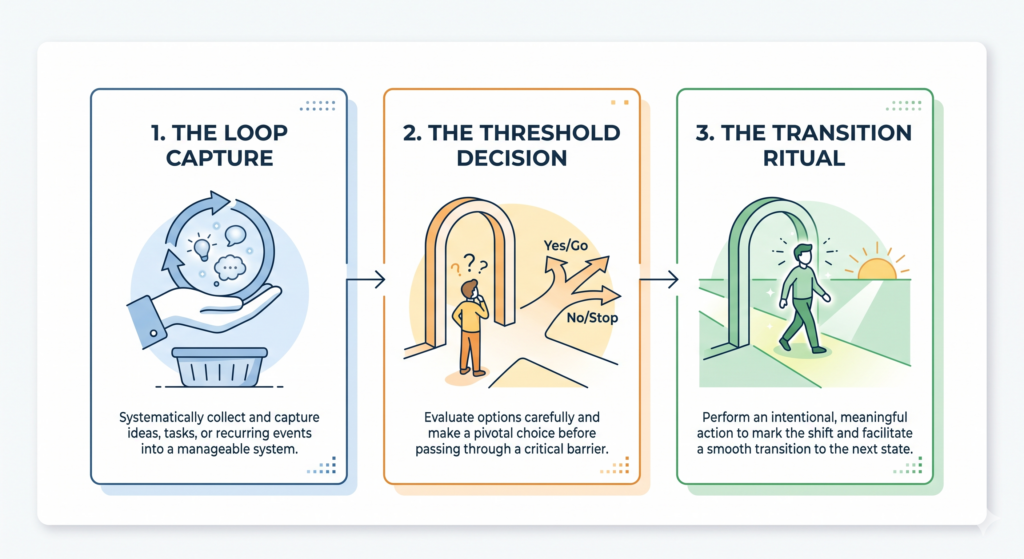
The Cognitive Shutdown Protocol
The fix is not a bedtime routine in the wellness sense. It is a structured end-of-day process that closes open loops before they follow you into sleep. Three steps. Each one serves a specific neurological function.
Step 1: The Loop Capture. Fifteen minutes before the end of your workday, write down every open loop. Every incomplete task. Every pending decision. Every conversation that needs to happen. Every unresolved item carrying any cognitive weight at all. Do not try to solve any of it. Just capture it.
This step works because of the same Zeigarnik research that identified the problem. Follow-up studies confirmed that writing down a specific plan for an incomplete task is sufficient to release it from working memory, even if the task itself is not yet done. The brain does not need the task to be complete. It needs to know the task has been acknowledged and assigned. Putting it on paper does that.
Step 2: The Threshold Decision. For each item on the list, make one of two assignments. Either schedule a specific time to handle it, which closes the loop, or consciously decide it does not need resolution today, which releases it. The goal is not to complete everything. The goal is to remove ambiguity. The brain keeps running tabs on things that have no assigned status. Remove the ambiguity and the tab closes. This step requires honesty. Some things that feel urgent are not. Some deferrals that feel reasonable are actually avoidance. The Threshold Decision forces a deliberate choice instead of a vague drift.
Step 3: The Transition Ritual. A deliberate, consistent signal that the cognitive workday is over. This can be physical, changing clothes, a short walk, making a specific drink. It can be verbal, saying out loud that work is done for the day. What matters is not the form but the consistency. The brain learns from repetition. A ritual performed consistently trains the nervous system to shift states. The transition is the bridge between operational mode and recovery mode. Without it, the bridge does not exist and the brain stays on the operational side indefinitely.
Tonight, before bed, spend five minutes writing down everything running in your head. Do not try to solve any of it. Just capture it on paper. Notice what happens to your body once it is external rather than internal. That release is not incidental. It is neurological.
The Application
A well-ordered mind does not happen by accident at night. It is built deliberately during the day.
Sleep quality is the report card for your daytime architecture. If the report card is bad, the problem is not the night, it is everything that led to it. The open decisions you deferred. The conversations you avoided. The loops you left running because closing them felt harder than carrying them.
The brain you bring to tomorrow is being shaped right now by how you close today.
Clock out. Tell it the day is done.
The rest will follow.