
I sat down to work on something that mattered last Tuesday morning.
Within four minutes I had checked my phone twice, opened a tab I did not need, and spent ninety seconds watching a video I cannot remember. The work was still there. Untouched. And I had not even noticed the drift until it was already done.
That used to feel like a discipline problem. A character flaw. Something to fix with better habits or stronger willpower.
It is not. What happened in those four minutes was the intended output of a system that thousands of engineers and behavioral psychologists spent years building. The drift was not accidental. It was designed.
TL;DR / Key Takeaways
- The average person now spends nearly 6 hours and 47 minutes per day on digital devices engineered to capture and hold attention.
- Short-form video formats have been shown in two independent lab studies to impair prospective memory so severely that users perform barely above random guessing on cognitive tasks.
- Reclaiming attention is not a productivity hack. It is an act of sovereignty. And it starts with understanding what you are actually up against.
How does the attention economy profit from your focus?
Here is the business model stated plainly.
Platforms do not sell products to you. They sell your attention to advertisers. You are not the customer. You are the inventory. Every minute you spend on a platform is a minute of attention converted into revenue, revenue that flows to the platform, not to you.
The scale of this operation is worth sitting with. Global digital advertising revenue is projected to exceed $700 billion. Meta and Google together capture more than half of all global digital advertising dollars. The infrastructure powering that revenue is built from one raw material: the focused attention of human beings who believe they are using a free service.
Tristan Harris, former design ethicist at Google, called this “human downgrading.” His argument was not that distraction is an unfortunate side effect of platform design. It is that the weakening of human attention, autonomy, and capacity for deep thought is the mechanism by which the business model functions. A more focused, less reactive user is a less profitable user. The system is working exactly as intended.
Think of it this way. Imagine a factory that extracts a raw material from billions of people simultaneously, packages it, and sells it to the highest bidder. The people being extracted from not only consent to this arrangement, they pay a monthly subscription fee for the privilege and carry the extraction device in their pocket at all times. That is the attention economy. The raw material is your focus. The product is your time. You are not the consumer. You are what is being consumed.
The full implications of this at a societal level are examined in The Attention Economy and the Collapse of Cognitive Autonomy, Georgetown Law.
Why is short-form video so hard on your memory?
The most important finding from recent research is not that social media is distracting. That much is obvious. It is that the format itself is the mechanism of damage.
In a controlled experiment at Ludwig Maximilian University of Munich, researchers interrupted participants with either TikTok, Twitter, or YouTube, then asked them to return to an original task. TikTok was the decisive destroyer. After using TikTok, participants’ performance on prospective memory tasks, the ability to remember to carry out an intended action, cratered so severely they were only slightly better than random guessing. Twitter and YouTube showed no measurable impact.
When researchers investigated why, controlling for social media addiction, absent-minded phone use, and general boredom, none of those factors explained the effect. The culprit was the format itself: rapid-fire short-form video combined with constant, frictionless task-switching. A completely independent research team replicated the results in February 2025. Two labs. Same result.
The cognitive mechanism behind this was mapped by Dr. Gloria Mark, whose research found that every task switch carries a “switch cost”, a measurable tax on cognitive performance. In a single short-form video session, a user might switch contexts hundreds of times. The cumulative cost is enormous. And critically, the damage does not stop when the phone goes down. The habit restructures how the brain operates across all tasks, not just the ones involving a screen.
Oxford’s word of the year for 2024 was “brain rot.” That is not casual cultural observation. It is the mainstream vocabulary catching up to what researchers have been documenting for years.
The average American office worker now maintains focus on a single task for just three minutes before being interrupted. College students average 65 seconds. These are not weak-willed people living undisciplined lives. This is an engineered collapse, documented across multiple independent research bodies and detailed in Attention: The Report Nobody Can Look Away From.
The Reclamation Protocol
Willpower is not the answer to a structural problem.
You cannot out-discipline a system designed by thousands of engineers and psychologists whose sole professional objective is to override your discipline. Motivation fades. Algorithms do not. The solution to a structural problem is a structural response, not a motivational one.
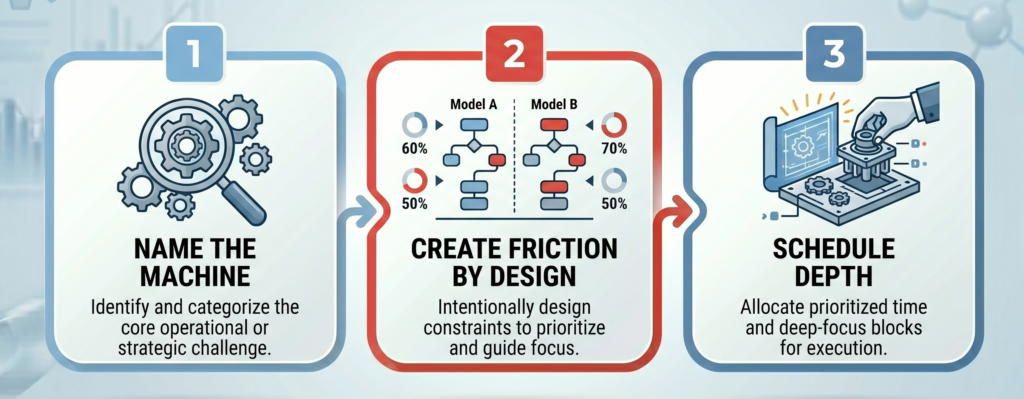
Here are three moves. Not tips. Moves.
Move 1: Name the Machine. Before anything else changes, the framing has to change. Distraction is not a personal failing. It is the intended output of a system working exactly as designed. When you pick up your phone and lose twenty minutes you did not plan to lose, that is not weakness. That is the product functioning correctly. Naming it accurately changes your relationship to it. You stop blaming yourself and start treating it as an adversarial design problem, which is what it actually is.
Move 2: Create Friction by Design. The platforms removed friction deliberately to lower the cost of engagement. Every swipe is instant. Every notification is immediate. Every next video is already loading. Your move is to add friction back, deliberately and structurally. Phone in another room during deep work. Notifications off by default, on by exception. App time limits set before the session begins. Not because you are weak. Because the playing field is engineered against you and you are choosing to level it.
Move 3: Schedule Depth. Deep focus does not happen in the gaps between distractions. It requires protected, pre-committed blocks of time with no permission to fragment. A minimum of 90 minutes. Nothing digital that is not directly required for the work. No exceptions during the block. This is not a productivity technique. It is the only environment in which your actual best thinking can occur.
One more thing before you move on. Check your screen time right now. The number will be uncomfortable. That discomfort is not guilt. It is data. Use it.
The Application
Cognitive autonomy is not a luxury. It is the foundation.
You cannot cultivate a beautiful mind while surrendering it to a machine designed to fragment it. Every principle Eunoia is built on, clarity, purpose, honest thinking, the ability to sit with a hard question long enough to find a real answer, requires a mind that is not constantly interrupted, redirected, and harvested.
The attention economy does not take your focus by force. It takes it by design, gradually, with your consent, and in exchange for content that feels free but costs more than any subscription.
The reclamation is not dramatic. It is structural. Three moves, applied consistently, over time.
Your attention is the most valuable thing you produce. Start treating it that way.