
I once watched a leadership team spend six weeks building a launch plan.
Every slide was polished. Every assumption was defended. Every stakeholder was aligned. The energy in the room when they greenlit it was the kind that makes people feel like they are part of something historic.
Four months later the project was quietly shelved. The reasons for its failure were not complicated. They were obvious in retrospect. Multiple people in that original room had seen the cracks. Not one of them said a word.
That is not a character failure. It is a structural one. And there is a tool that fixes it. Most leaders have never used it.
TL;DR / Key Takeaways
- The pre-mortem is a decision-making tool developed by cognitive psychologist Gary Klein that forces you to imagine a plan has already failed, before you execute it.
- Research shows prospective hindsight increases the accuracy of risk forecasting by 30%.
- Most leaders skip this step because optimism bias and groupthink make failure feel impolite to discuss. That silence is where decisions go to die.
Why do post-mortems come too late?
Most organizations are excellent at post-mortems.
They gather the team after a project collapses, document what went wrong, identify the failure points, and file a report that nobody reads before the next big decision gets made. The lessons are real. The timing is useless.
By the time a post-mortem happens, the cost has already been paid. The resources are gone. The opportunity is closed. The team has absorbed the damage. You are doing an autopsy on a patient who did not have to die.
Two cognitive patterns make this worse and they are present in almost every leadership environment.
The first is optimism bias. When we plan something ourselves, we systematically underestimate the probability that it will fail. Not because we are careless. Because the brain is wired to assign higher success probability to our own ideas than the data actually supports.
The second is groupthink. There is silent pressure in most planning meetings not to be the person who voices doubt when everyone else is excited. The leader has committed. The team is aligned. Raising a concern feels like disloyalty. So people stay quiet. And the quiet is where risk hides.
The result is a planning process that filters out the most important information available: the honest reservations of the people in the room.
Think of the standard kickoff meeting as a pre-flight safety briefing where everyone nods and no one actually checks the engines. The pre-mortem is the mechanic who opens the hood before the plane leaves the ground. The original methodology is detailed in Performing a Project Premortem, Harvard Business Review by Gary Klein, the cognitive psychologist who developed it.
Why does the pre-mortem work?
The pre-mortem works because of a specific quirk in how the brain processes risk.
When you ask a room full of people “what could go wrong with this plan?” they stay in planning mode. The brain treats the question as hypothetical. It generates cautious, hedged, socially acceptable answers. The real concerns stay buried.
But when you change the framing to “this plan already failed, walk me back through exactly how that happened,” something shifts. The brain moves into diagnostic mode. It stops protecting the plan and starts analyzing it. The same people who stayed quiet thirty seconds ago suddenly have specific, credible, uncomfortable things to say.
This is called prospective hindsight. And it is not a soft psychological trick. It is a measurable cognitive phenomenon.
Research from Wharton, the University of Colorado, and Cornell found that mentally transporting to a future failure state increased the ability to accurately forecast risks by 30%. That finding was later replicated in a study of 178 participants showing that pre-mortems reduced overconfidence in plans more effectively than either pros-and-cons analysis or critical review sessions.
Nobel laureate Daniel Kahneman, who spent his career studying how intelligent people make systematically poor decisions, called the pre-mortem his favorite tool for combating optimism bias. Not a useful tool. His favorite. The full method and its psychological basis are covered in The Pre-Mortem Method, Psychology Today.
The mechanism is a single grammatical shift. Past tense instead of future tense. That change alone moves the brain from defender of the plan to diagnostician of the failure.
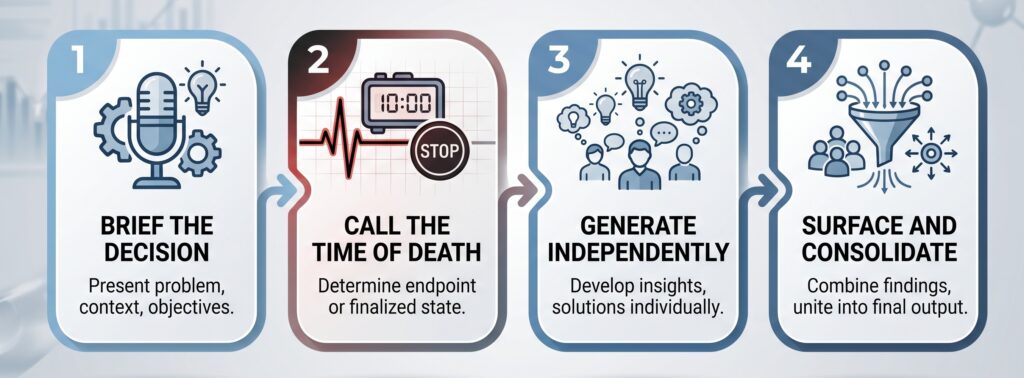
The Four-Step Pre-Mortem Protocol
The pre-mortem takes twenty to thirty minutes. It requires no special tools, no consultants, and no budget. It requires only the willingness to let failure into the room before it arrives uninvited.
Here is the protocol.
Step 1: Brief the Decision. Before anything else, every person in the room gets the full picture. Not a summary. Not a highlights reel. The complete plan, the assumptions underneath it, and the intended outcomes. Partial knowledge produces partial pre-mortems. Everyone needs the same starting point.
Step 2: Call the Time of Death. The facilitator, ideally not the most senior person present, makes one statement: “It is twelve months from now. This plan failed completely. We are here to find out why.” The plan is dead. That is the starting assumption. There is no debate about whether it failed. It failed. The only question is how.
Step 3: Generate Independently. Each person in the room spends three minutes writing down every reason they believe the failure occurred. Silently. Independently. This step is the structural fix for groupthink. The loudest voice in the room does not shape the list. The most senior person does not set the tone. Every perspective enters the process before the social dynamics of the room can filter it out.
Step 4: Surface and Consolidate. Each person reads one reason aloud in rotation until every reason is on the table. No objections. No defense of the plan. No debate. Just collection. The output is a complete map of identified failure points before a single dollar or hour has been spent executing the decision.
If you lead alone and have no team to run this with, the protocol still works. Sit down with the decision. Imagine the failure. Write the reasons. What surfaces in those three minutes will tell you more about your blind spots than any amount of optimistic planning.
The Application
Beautiful thinking is not optimistic thinking. It is clear thinking.
The pre-mortem is an act of intellectual honesty. It is the deliberate choice to look directly at the possibility of failure before the momentum of commitment makes that look feel disloyal or defeatist.
The leaders who build the most durable decisions are not the most confident ones in the room. They are the most honest ones. Confidence without examination is not a leadership asset. It is a liability dressed up as one.
The question most leaders avoid is the one that protects everything they are building.
Before your next significant decision, ask it. Assume the failure. Surface the reasons.
Then build a plan that can answer for them.