
The word is Latin. Cardo. It means hinge.
That is where the word cardinal comes from. Not important. Not foundational. Hinge. The thing a door cannot function without. The part you never notice until it fails.
Plato identified four virtues and called them cardinal because every other virtue depends on them. Aristotle built on them systematically. Aquinas refined them for centuries of practical application. For two and a half thousand years, across wildly different cultures and traditions, these four kept appearing at the center of every serious conversation about character, leadership, and how to live well.
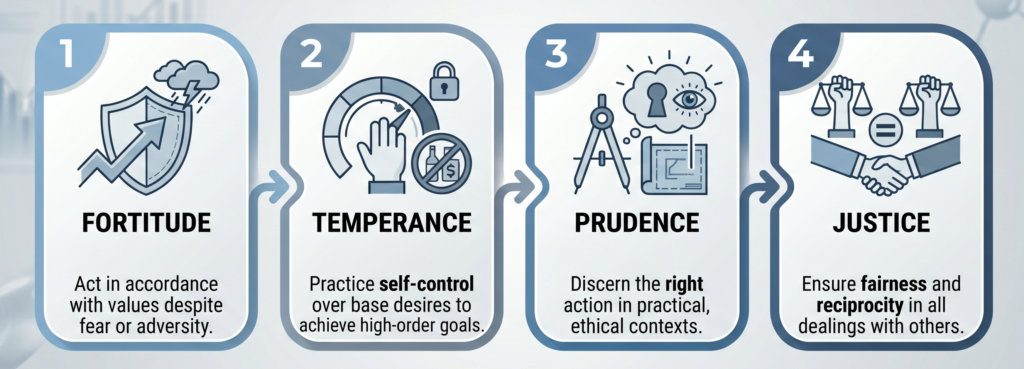
Prudence. Justice. Fortitude. Temperance.
Not aspirational qualities. Not personality traits to admire in others. Structural architecture. The hinges on which everything else turns.
TL;DR / Key Takeaways
- The four cardinal virtues are called cardinal from the Latin cardo, meaning hinge. Every other virtue depends on them.
- Empirical research on virtue-based leadership found these four function as a unified construct. You cannot develop one while neglecting the others. They stand and fall together.
- This week’s calibration: identify which of the four hinges is weakest in your current season. That is where this week’s work lives.
What are the four cardinal virtues?
Most people encounter these virtues as a list. A curriculum. Something to memorize and move past.
That is the wrong application. Each one is a diagnosis. A question the ancient world was asking about character that remains unanswered in most modern lives.
Prudence. Practical wisdom. Not caution for its own sake. The ability to see a situation clearly, think before acting, and choose the right course given the specific reality in front of you. Aquinas called prudence the “charioteer of the virtues”, without it, the other three have no direction. They are powerful but ungoverned.
In leadership terms, prudence is the gap between knowing what is right in theory and knowing what to do right now, in this room, with these people, under these conditions. It is the virtue that converts principle into action.
Justice. Giving what is owed. Not just legal fairness but relational honesty. What do you owe the people around you, your team, your family, your community? Honesty you have been withholding. Acknowledgment that is long overdue. Time and attention that has been promised and not delivered.
Justice is the only one of the four virtues directed fundamentally outward. Temperance and fortitude are concerned with the self. Prudence is concerned with clear thinking. Justice is concerned with others. It is the virtue that makes leadership social rather than solitary.
Fortitude. Not recklessness. Not aggression. The quiet internal steadiness that holds a position when holding it costs something. Prudence and justice determine what needs to be done. Fortitude ensures it actually gets done when pressure, fear, or exhaustion argue against it.
This is the virtue most people confuse with confidence. Confidence is a feeling. Fortitude is a practice. It does not require the absence of fear. It requires the decision to act correctly in spite of it.
Temperance. The mastery of appetite. Not abstinence, but calibration. The ability to keep desire from overriding reason, the desire for approval, for comfort, for certainty, for the path of least resistance. In a world engineered to maximize appetite and minimize friction, temperance is the most structurally rebellious of the four.
The full philosophical and practical framework for prudence in leadership is examined in Prudence: The Essential Virtue for Ethical Leadership in Management, Admethics.
Can you develop one cardinal virtue without the others?
Here is where most leadership development gets this wrong.
It treats the four virtues as separate traits to be developed independently. Build more courage. Practice more patience. Work on your fairness. Each virtue isolated, optimized, and checked off.
The research says otherwise. When scholars developed an empirical measure of virtue-based leadership using these four as the framework and ran the data across thousands of leaders, factor analysis suggested they function as a single unified construct. Not four separate traits. One integrated character. The findings, linking this construct directly to transformational leadership, authentic leadership, and ethical leadership measures, are detailed in the research on virtues and leadership across Aristotelian and Confucian frameworks, ResearchGate.
The ancient philosophers understood this two thousand years before the data confirmed it.
Aquinas wrote that none but the prudent person can be truly just, brave, or temperate, because without practical wisdom directing the other three, they operate without a compass. The consequences of that misdirection are not neutral.
Fortitude without prudence is not courage. It is recklessness. The person who charges ahead without clarity about whether the charge is warranted.
Temperance without prudence is not self-discipline. It is fanaticism. Restraint applied indiscriminately without the wisdom to know when action is required.
Justice without prudence is not fairness. It is impulsiveness. The right intention delivered at the wrong moment in the wrong way to the wrong person.
This is the Unity Problem. You cannot build one hinge and ignore the others and call it character. The door does not hang on one hinge. It hangs on all four.
This Week’s Protocol: The Hinge Audit
Every Sunday Calibration ends with one practice to carry into the week.
This week it is the Hinge Audit. Four questions. One for each virtue. Honest answers only. The whole exercise takes less than five minutes and reveals more than most people are comfortable knowing.
Prudence: In my most recent significant decision, did I act from clear thinking, or from pressure, habit, or unexamined emotion?
Justice: Who in my life is owed something from me right now, honesty, acknowledgment, time, or effort, that I have not yet given?
Fortitude: What is the thing I know needs to be done that I have been avoiding because it is hard, uncomfortable, or costly?
Temperance: Where is my appetite, for approval, for comfort, for certainty, currently overriding my better judgment?
The weakest answer is the week’s work. Not all four. The one that stings most. That is the hinge that needs attention before the others can function properly.
These are not new questions. They are the oldest questions in the Western moral tradition. They have survived two and a half thousand years because they remain unanswered in most lives.
Not because people lack intelligence.
Because answering them honestly requires something rarer.