

I was in the middle of an important piece of work last year when I noticed I had checked my bank account three times in forty minutes.
Not because anything had changed. Not because there was an action to take. Just because the financial worry was running, and the mind kept returning to it the way a tongue returns to a recently chipped tooth. The work was open in front of me. My attention was somewhere else entirely.
I thought it was a focus problem. The research says it is something more structural than that.
TL;DR / Key Takeaways
- Harvard and Princeton researchers found that financial stress reduces cognitive performance by the equivalent of 13 IQ points. Not in different people, in the same person, before and after financial pressure.
- The mechanism is cognitive bandwidth: scarcity consumes the mental resources used for planning, problem-solving, and impulse control, leaving less available for everything else.
- This is not a money problem disguised as a thinking problem. It is a thinking problem caused by money stress. The entry point for fixing it is not a budget. It is the mind.
How does financial stress lower your IQ?
In 2013, Harvard economist Sendhil Mullainathan and Princeton psychologist Eldar Shafir published research that fundamentally changed how scientists understand the psychology of financial stress.
They tested sugarcane farmers in India twice: two months before harvest, when money was scarce, and two months after harvest, when they had been paid. Same people. Same cognitive tests. Same environment. The only variable was financial stress.
Before harvest, the farmers performed significantly worse. After harvest, their scores recovered completely. The cognitive deficit was equivalent to 13 IQ points (roughly the difference between a full night of sleep and pulling an all-nighter).
They replicated this in a New Jersey shopping mall. Rich and poor shoppers performed identically on cognitive tests when the financial stakes in the scenario were low. When researchers introduced a high-cost financial problem, poor shoppers’ scores dropped significantly. Rich shoppers were unaffected. The variable was not intelligence or character. It was bandwidth occupation.
The mechanism is straightforward once you understand it. Financial worry does not sit quietly in the background. It runs continuously. It pulls at attention, revisits the same numbers, imagines scenarios, recalculates outcomes. Every cognitive cycle spent on the money problem is a cycle not available for the work in front of you. The research framing is precise: scarcity consumes mental bandwidth, the cognitive capacity used for planning, problem-solving, abstract reasoning, and impulse control.
The full research is detailed in Scarcity: Why Having Too Little Means So Much, Behavioral Scientist.
Here is the Eunoia reframe, and it matters: this is not a character flaw. It is not irresponsibility, weakness, or poor discipline. It is a measurable structural cost that the research has now quantified precisely. Treating financial anxiety as a moral issue is not only wrong, it adds shame on top of the original stress, and shame consumes bandwidth too.
What is tunneling and why do financial problems compound?
The second mechanism the research identified is what Mullainathan and Shafir called tunneling.
Scarcity narrows the mind’s focus to the immediate problem and compresses its capacity for peripheral vision. In the very short term, this is actually an asset. People under financial pressure often have a sharper, more precise sense of costs and value than those who are financially comfortable. The mind concentrates on what is most pressing.
The cost of the tunnel is everything outside it.
Long-term planning collapses. Abstract problem-solving degrades. The capacity to think beyond the immediate crisis shrinks significantly. Decisions that seem rational in the moment, the high-interest loan, the quick fix, the short-term relief that creates a longer-term problem, are made with a mind that literally cannot access its full capacity for evaluating consequences beyond the immediate situation.
This is why financial problems compound. The stress of the problem reduces the cognitive capacity needed to solve it. The worse the situation, the narrower the thinking, the worse the decisions, the worse the situation. It is a self-reinforcing loop and it runs entirely on cognitive resources, not moral character.
More on the mechanism and its implications is covered in Poor Concentration: Poverty Reduces Brainpower Needed for Navigating Other Areas of Life, Princeton University.
Think of it this way. A computer running 20 background programs simultaneously has the same hardware as one running nothing but the task in front of it. The processor has not changed. The available capacity has. Financial anxiety is the background programs. Your thinking is the application you are trying to run. The errors and slowdowns are not a hardware problem. They are a resource allocation problem.
The Bandwidth Recovery Protocol
The counterintuitive finding from the research is this: the entry point for recovery is not financial. It is cognitive.
You cannot think your way out of a financial problem with a mind that is already overtaxed by the financial problem. The first move is to reduce the bandwidth cost. Not solve the money. Reduce what the money stress is consuming so that the mind can actually function well enough to engage with the situation clearly.
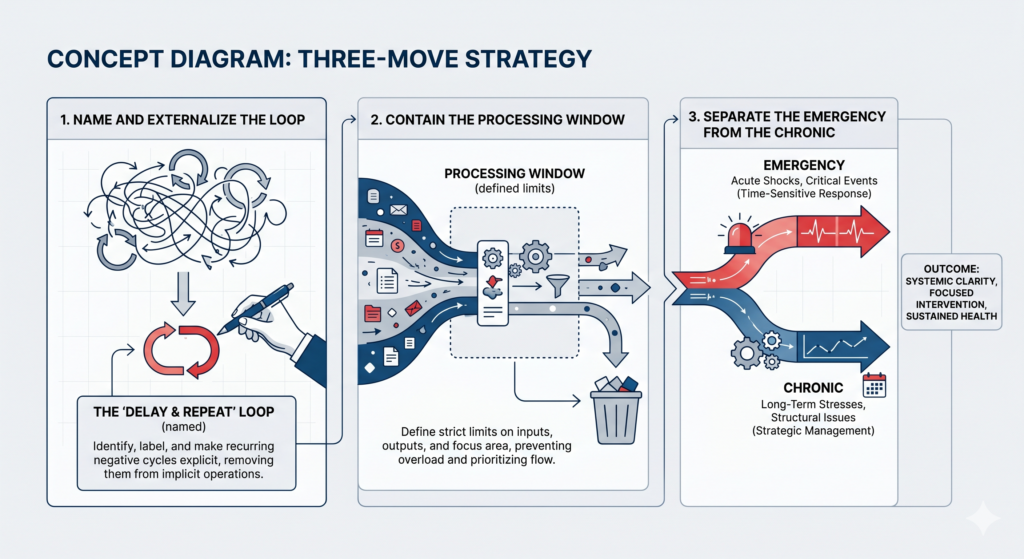
Three moves. These are not financial advice. They are a cognitive protocol.
Move 1: Name and Externalize the Loop. The financial worry running in the background consumes bandwidth whether or not it is being consciously processed. Writing it down (the specific number, the specific fear, the specific scenario) externalizes it. The same principle from the Zeigarnik Effect applies here: the brain partially releases a loop it has acknowledged and recorded, even before the problem is solved. Get the anxiety out of working memory and onto paper. Name the actual number. Name the actual fear. The mind stops rehearsing what it has already captured.
Move 2: Contain the Processing Window. Financial anxiety runs continuously because it has no designated time. It fills available cognitive space by default because it has been given no container. Assign it a specific window (20 minutes, once a day, at a fixed time) to think about the money. Outside that window, it does not get floor time. This is not avoidance. It is triage. The worry gets processed deliberately, in a contained space, rather than leaking across every other cognitive task throughout the day.
Move 3: Separate the Emergency from the Chronic. Financial stress frequently conflates immediate crises with chronic background anxiety. They require entirely different responses. An immediate crisis (a bill due today, an account in overdraft right now) requires action. Chronic background anxiety about financial stability is a different problem and requires a different approach. Most people treat the chronic as though it is always an emergency. That keeps the bandwidth tax running at maximum indefinitely. Separating the two allows the mind to downgrade the chronic from emergency status, which partially restores available bandwidth even before the financial situation changes at all.
Before you move on, try the first move right now. Identify one financial worry currently running in your background. Write it down. The specific number or scenario. Notice what happens to the cognitive pressure once it is external rather than internal.
The Application
A well-ordered mind requires cognitive resources to operate. Financial anxiety is one of the most consistent and precisely measurable drains on those resources in modern life.
Addressing it is not about wealth. It is about recovering the mental bandwidth that clear thinking requires. The 13 IQ points are not gone. They are occupied. The protocol is about freeing them up.
This is the first of three posts on financial psychology. The next installment examines where financial beliefs come from and why they drive behavior in ways most people never stop to examine.
For now: the most important financial move you can make today is not a budget adjustment. It is getting the loop out of your head and onto paper.
Start there.










You must be logged in to post a comment Login