

I asked an AI tool to help me think through a problem last year.
The answer came back in eleven seconds. It was structured, coherent, and covered the main angles. I copied the key points, moved on with my day, and felt productive.
Three days later I was in a conversation where that same problem came up. And I had nothing. No real opinion. No texture. No sense of how I’d actually arrived at the position I’d adopted. The answer had been there. The thinking never happened.
That gap between having an answer and having done the thinking is not a minor inefficiency. It is, according to a growing body of research, one of the most significant cognitive risks of our time.
TL;DR / Key Takeaways
- MIT Media Lab research found that AI users had the lowest brain engagement of any group studied — lower than Google users, lower than those who used no tools at all.
- The brain has a background processing mode where incubation, connection-making, and original insight actually happen. AI bypasses it entirely.
- Using AI for answers is not the problem. Outsourcing the thinking that should produce those answers is.
The Cognitive Debt
Cognitive offloading is not new. We have been doing it for decades.
We stopped memorizing phone numbers when we got smartphones. We stopped navigating when we got GPS. We stopped retaining information we knew we could search in seconds. Researchers at Columbia and Harvard called this the Google Effect — the systematic reduction in what we bother to remember because external memory has become frictionless.
AI takes this further. It does not just store information on our behalf. It reasons on our behalf.
A study from MIT’s Media Lab divided 54 participants into three groups and asked them to write SAT essays using ChatGPT, Google, or nothing at all. Researchers used EEG technology to measure brain activity across 32 regions during the task. The results were unambiguous. ChatGPT users showed the lowest brain engagement across every region measured. Not just lower recall. Lower neural activity. The brain was not doing the work because it did not need to.
The researchers described the cumulative effect of this pattern as cognitive debt. Every time you hand a reasoning task to an external tool, you make a withdrawal from your capacity to reason independently. For occasional use, the account recovers. For habitual use, the balance runs low. The capability does not disappear. It atrophies.
The full implications of this for how we work and think are examined in Is AI Dulling Our Minds, Harvard Gazette.
The Simmer Setting
Here is what gets bypassed when you skip straight to the answer.
The brain operates in two modes that matter for this conversation. The focused mode is active and directed — the mode you are in when you are consciously working through a problem. The default mode network is something different. It is the background hum that activates when you are not actively concentrating. When you are in the shower. On a walk. Staring out a window. Sitting in traffic with no podcast on.
This is not wasted mental time. It is where incubation happens. Where the brain takes material from your focused sessions and begins quietly connecting it to everything else it knows. Where analogies surface unexpectedly. Where the solution to a problem you stopped consciously working on arrives while you are doing something entirely unrelated.
This is the simmer setting. And it cannot be rushed.
A stock made from a bouillon cube and hot water is technically broth. It has the right color. It checks the surface boxes. But it has no depth, no body, no complexity — because complexity in a stock develops through hours of low heat that cannot be replicated by adding more heat faster. Thought works the same way. An answer generated in eleven seconds has none of the structural integrity that develops through real cognitive processing. It is bouillon. It passes the first look. It does not hold up when pressure is applied.
Microsoft Research surveyed 319 knowledge workers across occupations and collected 936 real-world AI use cases in their 2025 CHI study. What they found was a consistent pattern: for low-stakes tasks under time pressure, people offloaded thinking to AI and experienced it as easier and faster. But for high-stakes reasoning tasks, AI use produced shallower analysis and narrower thinking — and participants reported that applying real critical scrutiny to AI outputs felt harder than doing the task without AI at all. The ease was the cost in disguise. The full study is covered in The Future of AI in Knowledge Work, Microsoft Research CHI 2025.
The Cognitive Simmer Protocol
This is not an argument against using AI. It is an argument for using it in its correct position in the thinking sequence — which is not first.
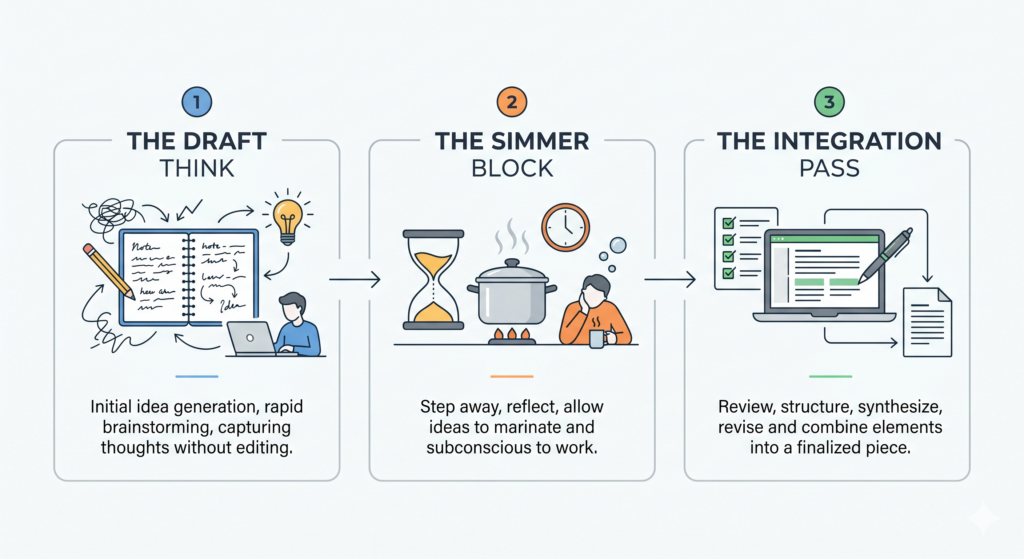
The Cognitive Simmer Protocol has three stages.
Stage 1: The Draft Think. Before you go to AI for anything, spend five minutes with the problem yourself. Write down what you already know. What you think the answer might be. What you are actually uncertain about. This is not about producing the right answer before the AI does. It is about activating the brain before outsourcing any of the work. A mind that has already engaged with a problem will interrogate an AI output far more effectively than one that encounters the answer cold.
Stage 2: The Simmer Block. Once a day, minimum 20 minutes, no input. No phone. No content. No AI. Just a problem or question you are sitting with. Walk. Sit. Stare out a window. Let the default mode network do what it was built to do. The discomfort of doing nothing with an active mind is the signal that the simmer is working. This is where your best thinking will happen — not in front of a screen, not in eleven seconds, and not by asking.
Stage 3: The Integration Pass. After using AI, do not accept the output. Interrogate it. What do you agree with? What feels wrong or incomplete? What did it miss that you already knew? What would you add or change? This pass is where you reclaim the cognitive work the AI did on your behalf and make the thinking actually yours. Without this step, you have an answer. You do not have a position.
Before you move on from this post, try the simplest version of Stage 1. Think of a problem or decision you are currently sitting with. Do not search for it. Do not ask anything. Spend five minutes with it right now. What you produce in those five minutes belongs to you in a way that no generated output ever will.
The Application
Beautiful thinking cannot be outsourced.
It is the product of a mind that has done the work, sat with the difficulty, tolerated the discomfort of not knowing, and arrived somewhere through its own process. That process is slow by design. The default mode network does not operate on demand. Incubation cannot be prompted.
AI can be a tool inside that process. It can pressure-test a position you have already formed. It can surface angles you missed. It can accelerate the research phase of a question you have already engaged with. What it cannot do is replace the engagement itself.
The simmer is not inefficiency. It is where the depth comes from.
Turn down the heat. Give it time.















You must be logged in to post a comment Login