

Most people enter their careers with a reasonable expectation.
Work hard. Demonstrate potential. And someone, a manager, a senior leader, or the organization itself, will notice and invest in your development. They will open doors, share wisdom, accelerate your growth, and help you become what you are capable of becoming.
It is not an unreasonable expectation. It is simply not a reliable one.
In 2026, organizational development programs are stretched thin, leadership bandwidth is compressed, and formal mentorship structures, where they exist, depend almost entirely on whether two people happen to connect well enough for the relationship to produce anything useful. The people waiting to be developed are falling behind the people who stopped waiting.
TL;DR / Key Takeaways
- Over 92% of Fortune 500 companies have mentoring programs, but most are 1:1 models that depend entirely on a single relationship. Research from Babson College confirms this is the most common and costly mistake in mentorship.
- In 2026, career development is not assigned. It is architected. The people growing fastest are building deliberate advisory structures, not waiting to be developed.
- The Personal Board of Advisors is a practical framework for building the mentorship infrastructure your organization will not build for you.
The Development Gap
Most organizational development programs are designed for populations, not individuals. They address the average need across a workforce. If your needs are specific, and the most important developmental needs almost always are, the average program will not meet them.
The 1:1 mentorship model compounds this problem. It concentrates the entire developmental relationship into a single person who may be excellent in some areas and limited in others, who carries their own biases and blind spots, and whose availability is constrained by their own competing demands. When the relationship works, it works well. When it does not, the person receiving mentorship has no fallback, and often no clear way to know what they are missing.
A Babson College professor of management, writing in Entrepreneur after decades of studying how mentors boost individual development across thousands of students and executives, identified this as the single most common and most costly mistake in mentorship. More than 92% of Fortune 500 companies have mentoring programs in place. But most are 1:1 models. The research conclusion is direct: quality relationships with diverse mentors produce significantly better developmental outcomes than any singular relationship can provide. The full analysis is covered in An Expert Explains Why You Need a Personal Board of Advisors, Entrepreneur.
The development gap is not a motivation problem. It is a structure problem. Most people who are not growing at the rate their potential allows are not being held back by lack of ability. They are making important decisions without enough perspective. They are running into obstacles that someone with relevant experience could help them navigate in a single conversation. They are operating with insufficient input and calling it independence.
The Personal Board of Advisors
The personal board of advisors is not a formal structure with titles and meeting minutes. It is a deliberately assembled group of people who collectively provide the input, perspective, and challenge that no single mentor can.
MIT Sloan Management Review identified the key insight in their framework for Assembling Your Personal Board of Advisors: different advisors serve different developmental functions. No single person can serve all of them. The mistake is treating mentorship as a single role rather than a portfolio of roles.
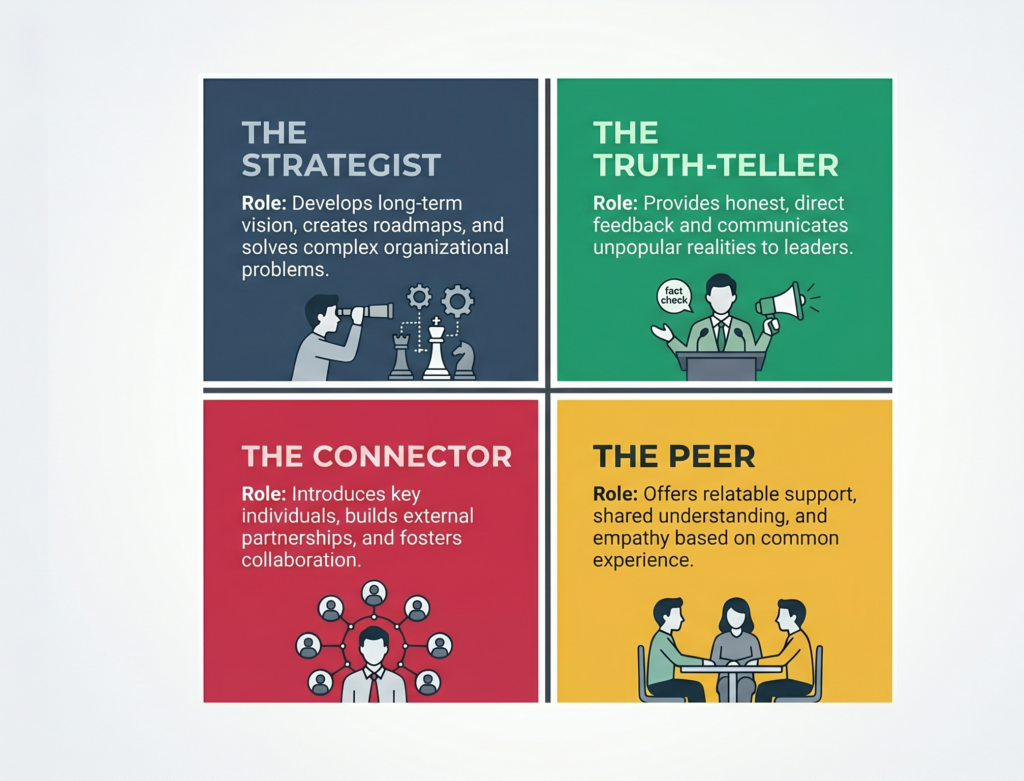
Four distinct seats. Each one serves a different function.
The Strategist. Someone who has navigated territory ahead of where you currently are and can help you see around corners. Not necessarily someone in your exact field. Someone whose strategic thinking you respect and who can help you think about the long arc rather than just the next move. This person is most valuable when you are facing major decisions, transitions, or inflection points where the stakes are high and the visibility is low.
The Truth-Teller. Someone who will tell you what you need to hear rather than what you want to hear. This is the rarest and most valuable seat on the board. Most people in professional relationships have an incentive to be polite. Colleagues need to work with you. Managers need to maintain the relationship. The truth-teller has earned the right to be direct and chooses to use it. Without this seat, your blind spots stay blind indefinitely. They will be pointed out eventually. Just not by someone trying to help you.
The Connector. Someone with a broad and active network who thinks naturally in terms of relationships and introductions. Career development is not only about what you know and what you can do. It is about who knows you and in what context. The connector expands both. They are not your publicist. They are the person who, when a relevant opportunity or relevant person crosses their path, thinks of you specifically.
The Peer. Someone at roughly your level who is navigating similar challenges in real time. Not above you and not below you. Someone who can say “I am dealing with the same thing” and actually mean it. The peer mentor is one of the most underutilized developmental relationships available, precisely because it does not look like mentorship in the traditional sense. But the thinking that happens between equals, without hierarchy, without performance, is often the most honest and most useful thinking available.
The Board Builder Protocol
Three moves. Not a networking strategy. A deliberate construction process.
Move 1: Map the gap before you recruit. Before approaching anyone, identify the specific developmental need you are trying to address. What decisions are you consistently making without enough perspective? What areas of your thinking are going unchallenged? What do you not know about the territory ahead of you that someone with experience could illuminate? The gap defines the role. The role defines the person you are looking for. Most people approach mentorship by asking “who should I talk to?” The right question is “what do I need that I currently do not have?”
Move 2: Make the ask specific and low-cost. The most common reason people do not reach out to potential advisors is fear of imposing. The research is clear: reaching out for mentorship is almost always welcomed when the ask is specific and bounded. Not “would you be my mentor?” That is an open-ended commitment most people will hesitate to accept regardless of their goodwill toward you. Instead: “I am navigating a specific challenge and your experience in this area is directly relevant. Could I have 30 minutes?” A specific ask produces a specific response. A vague ask produces a polite delay that eventually becomes a no by silence.
Move 3: Make the relationship worth their time. The most sustainable advisory relationships are not one-directional. The advisor needs something from the exchange too. Not necessarily the same thing you need, but something. It might be intellectual engagement, connection to a different perspective, a sense of genuine contribution, or the satisfaction of watching someone take their input seriously and act on it. Your job is to show up prepared, take the feedback seriously, report back on what you did with it, and make the relationship feel like it matters. Advisors whose input disappears into silence do not give more of it.
Before you move on: identify one specific developmental gap right now. One area where you are consistently making decisions without enough perspective. Who in your current network has experience in that territory? If the answer is no one, that is the first seat to fill.
The Application
Leadership and personal growth are not passive processes. They require the same deliberate architecture as any other system worth building.
The expectation that development will be provided for you was not wrong when it formed. It simply does not match the environment most people are actually operating in. Organizations have their own priorities. Managers have their own demands. The formal structures that exist are built for the average case, not yours.
The people who are growing are building the infrastructure themselves. Deliberately, specifically, and without waiting for permission or assignment.
Nobody is coming.
Build the board.















You must be logged in to post a comment Login