

I had 11 active projects running simultaneously at one point last year.
Not 11 tasks. 11 projects. Each with its own context, its own stakeholders, its own set of open decisions. I was moving on all of them. I was completing almost none of them well. And I was exhausted in a way that more sleep was not fixing.
The problem was not the workload. It was the structure. And the structure had a name I had not yet learned.
TL;DR / Key Takeaways
- Hustle culture measures productivity by visible activity. Slow productivity measures it by quality of output. The two are not the same, and they often move in opposite directions.
- Sports science has documented that training without adequate recovery produces overtraining syndrome: physical and cognitive decline. The same mechanism produces burnout in knowledge workers.
- Doing fewer things at a natural pace, with an obsession over quality, is not a rejection of ambition. It is the highest-performance strategy available for sustained, meaningful output.
What is pseudo-productivity?
Most modern workplaces cannot directly observe whether a knowledge worker is thinking productively or spinning their wheels. The output of a lawyer, a strategist, a writer, or a designer is not visible the way a manufactured unit is visible. So organizations default to the next best thing: observable activity. And individuals, consciously or not, optimize for what is being measured.
The result is what Cal Newport calls pseudo-productivity: treating visible activity as a proxy for useful effort. Replying to emails fast. Attending every meeting. Keeping the calendar packed. Being the person who is always doing something. These things signal commitment. They do not necessarily produce output.
Newport spent years studying how this pattern developed and what it costs. In his 2024 book, Slow Productivity: The Lost Art of Accomplishment Without Burnout, he makes the case that the most accomplished people in history worked far fewer hours and carried far fewer simultaneous commitments than the modern knowledge worker. Darwin took three walks a day and rarely worked past noon. Jane Austen wrote in short, protected sessions. Newton retreated for months at a time to think without interruption.
Their output was not extraordinary despite their pace. It was extraordinary because of it.
The knowledge worker in 2026 is genuinely exhausted and, in many cases, genuinely underproducing at the same time. The activity is real. The output is not proportional to it. And because the exhaustion is real, the intuitive solution feels like rest. But more rest does not fix a structural problem. The problem is not the quantity of work. It is the architecture of it.
How is burnout like overtraining syndrome?
Sports science has known for decades what knowledge work is only beginning to understand.
More training does not produce more performance. Past a certain threshold, it produces less.
Elite coaches have known this for generations. The discipline that produces championship-level performance is not maximum intensity every day. It is periodization: deliberate cycles of load and recovery, structured so that adaptation happens during the recovery phase, not the training phase. The performance improvement comes from the rest. Not despite it.
Overtraining syndrome is what happens when load accumulates without recovery. Physically, athletes break down. But the research reveals a less visible second effect: cognitive impairment. A systematic review from Deakin University found that overtraining in endurance athletes produced measurable deficits in decision-making, memory, learning, and reaction time. The body breaks down visibly. The brain breaks down quietly, without obvious signal, until the deficit is large enough to notice.
The parallel to knowledge work is not metaphorical. It is physiological. A paper in the journal Frontiers in Medicine made the link explicit: burnout is the non-athletic equivalent of overtraining syndrome in under-recovered workers. Same mechanism: chronic stress load without adequate recovery. Same cortisol dysregulation. Same cognitive and emotional impairment. The full research is detailed in Impact of Overtraining on Cognitive Function in Endurance Athletes, Sports Medicine Open.
Think of it this way. No serious coach tells athletes to train at maximum intensity every day because they want maximum performance on race day. The math does not work that way. The adaptation requires the recovery. The performance requires the rest. A packed calendar does not change the underlying biology. The same organism is operating the same nervous system. The output degrades whether or not the environment labels it as training.
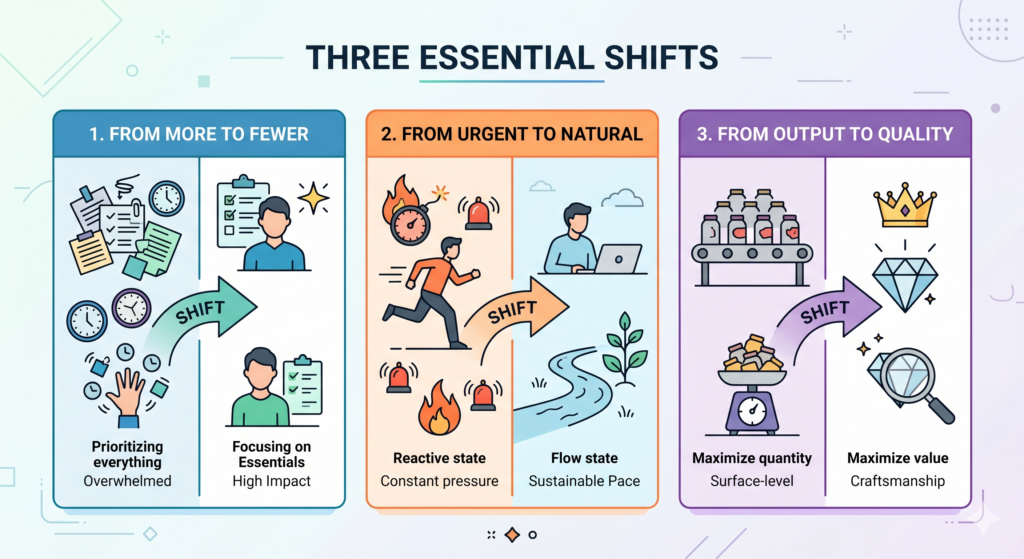
The Three Shifts
Newport’s framework has three principles. Applied through the Eunoia lens, they become three structural shifts in how you relate to your work.
Shift 1: From More to Fewer. The first shift is reducing simultaneous active commitments. Not tasks within a project, projects themselves. The research on cognitive load is unambiguous: every time you switch context between active projects, you incur a switching cost. Attention fragments. Working memory has to reload a different context. The more projects running simultaneously, the higher the accumulated switching cost across every working hour.
Maintaining fewer active commitments allows deeper engagement with each one, higher quality output, and faster completion, because the full cognitive resource is present rather than divided. The discipline is not in working harder on what you have. It is in saying no to more things before they enter the system.
Shift 2: From Urgent to Natural. The second shift is resisting artificial urgency. Not every deliverable is as time-sensitive as it presents itself. Not every message requires a response within the hour. The question is not “how fast can I complete this?” but “what pace produces the best result without accumulating cognitive debt I cannot pay back?”
Working at a natural pace means matching the speed of your effort to the nature of the work, rather than to the ambient anxiety of the environment. Some work requires deep, slow thinking. Forcing it to happen at the speed of a reactive inbox produces the wrong output at the right speed. The efficiency is illusory.
Shift 3: From Output to Quality. The third shift is the one that changes the relationship to work entirely. When quality is the primary metric rather than volume, a few things done well become more valuable than many things done adequately. This is not a perfectionism argument. It is a strategic one.
Work of genuine quality compounds. It builds reputation, opens opportunities, and creates the conditions for more meaningful work. Work done at volume without quality does none of those things. It fills the calendar and empties the account.
Before you move on: how many active projects are you genuinely running right now? Not your task list. Active projects with open decisions, moving parts, and cognitive load attached. If the number is more than three or four, the quality of each one is being taxed by the presence of the others. That tax is the cost of the structure, not the cost of your capacity.
The Application
Slow productivity is not a productivity philosophy. It is a philosophy of how a well-ordered mind engages with work.
The goal was never to do more. It was to do what matters, at a pace that is sustainable, with the quality that makes it worth doing. Those three things are not in tension with ambition. They are what ambition looks like when it is structured rather than performed.
This is not anti-hustle as an identity. It is pro-output as a practice.
The distinction is everything. And it starts with the number of projects currently open on your desk.











You must be logged in to post a comment Login