

Aristotle wrote his treatise on happiness in the fourth century BC and spent the first chapter of it arguing that most people have the wrong definition.
Not a wrong preference. A structural error. They are pursuing something that cannot, by its nature, produce what they are actually looking for. And the pursuit itself is part of what prevents them from finding it.
He called the right target Eudaimonia. It is usually translated as happiness. That translation is close enough to be useful and wrong enough to cause serious problems.
TL;DR / Key Takeaways
- Eudaimonia, from Aristotle’s Nicomachean Ethics, is often translated as happiness but means something closer to flourishing. It is not a feeling you pursue. It is a condition you build through activity aligned with your highest capacities.
- The modern pursuit of happiness is largely hedonic: seeking positive emotion and avoiding negative emotion. Research consistently shows hedonic happiness is unstable, adaptive, and ultimately unsatisfying as a life goal.
- This week’s calibration: the Flourishing Audit, three questions that distinguish whether you are pursuing hedonic happiness or eudaimonic flourishing in your current season.
The Wrong Target
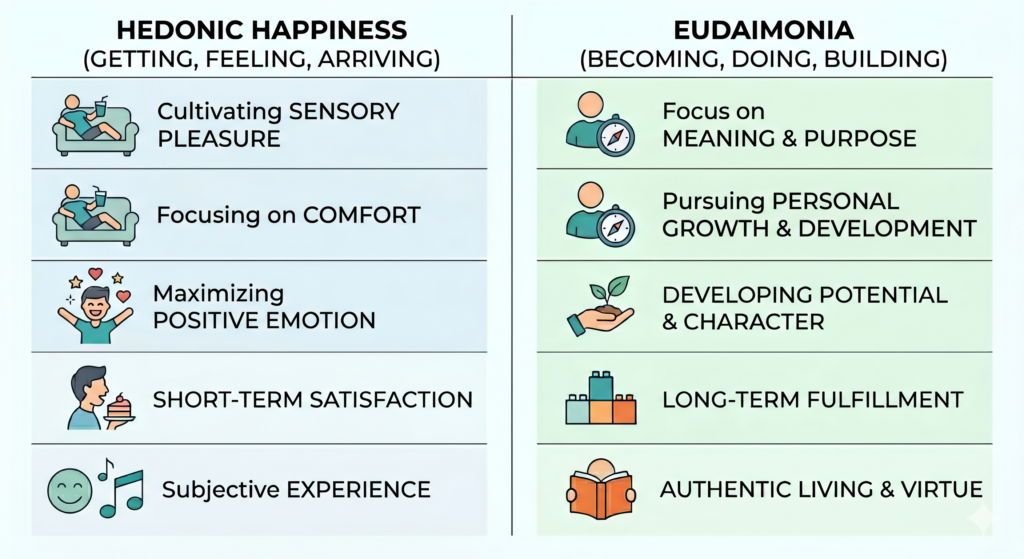
Modern psychology has a name for the happiness most people are pursuing: hedonic wellbeing. Positive emotion in, negative emotion out. Satisfaction with life circumstances. More pleasure, less pain. Most of the wellness industry, most of the self-help genre, and most of the productivity optimization culture are built on hedonic premises. Get more. Feel better. Optimize the experience.
The problem is documented and precise. It is called the hedonic treadmill.
Every positive experience produces a temporary elevation in happiness, after which the baseline returns. Every achievement, purchase, relationship milestone, and life upgrade produces a peak followed by adaptation. The baseline reasserts itself. The treadmill keeps running. This is not a failure of gratitude or mindset. It is the documented behavior of the hedonic system. It was designed by evolution to keep the organism moving toward the next thing, not to produce sustained contentment with any particular thing. Hedonic happiness is a moving target by design. You are not failing to catch it. It is designed to stay just ahead of you.
Aristotle saw this problem clearly two thousand years before the research confirmed it. His answer was not that happiness is impossible. It is that the happiness most people are pursuing is the wrong kind.
Happiness is getting. Eudaimonia is becoming. That single distinction changes the entire strategy. The full modern leadership analysis of what this distinction means in practice is examined in Eudaimonia: Human Flourishing vs Happiness in Modern Leadership, Derek Neighbors.
What Eudaimonia Actually Requires
Aristotle defined Eudaimonia as “an activity of the soul in accordance with virtue over a complete life.”
Three words in that definition deserve attention before anything else.
An activity. Not a state. Not a feeling. Not something that happens to you when the circumstances align correctly. Something you do. Eudaimonia is not produced by acquiring the right circumstances. It is produced by engaging in the right kind of activity. This is the most important word in the definition and the one most consistently missed. Most people are waiting for the conditions that will allow them to flourish. Eudaimonia does not wait for conditions. It is generated by the activity itself.
In accordance with virtue. Not any activity. Activity that draws on and develops what is best in you. Your highest capacities, your deepest values, your fullest potential. This is why the cardinal virtues from the Week 7 calibration are not constraints on happiness. They are the architecture of it. Prudence, justice, fortitude, temperance — these are not rules for limiting pleasure. They are the operating system that makes genuine flourishing possible.
Over a complete life. Not in a moment. Not in a season. Not in the next quarter. Eudaimonia is what a life looks like when assessed across its full arc, not what any given day feels like. This is the reframe that most directly challenges the modern optimization culture. You cannot sprint your way to flourishing. It is a trajectory, not a destination.
Modern research confirms the structure Aristotle identified. Self-Determination Theory, developed by Deci and Ryan, identifies three core conditions for eudaimonic wellbeing: autonomy, acting from your own values rather than external pressure; competence, developing genuine skill and mastery; and relatedness, meaningful connection with others. All three are active pursuits. None of them are states you arrive at. All of them are practices you maintain. The academic analysis connecting Aristotelian flourishing to contemporary wellbeing theory is published in Aristotelian Flourishing and Contemporary Philosophical Theories of Wellbeing, Journal of Happiness Studies.
This Week’s Protocol: The Flourishing Audit
Every Sunday Calibration ends with one practice to carry into the week.
This week it is the Flourishing Audit. Three questions that distinguish whether what you are currently doing is building toward flourishing or optimizing for temporary elevation.
Question 1: Am I becoming something through what I am doing? Not “am I enjoying this” — that is the hedonic question. The eudaimonic question is: “Is this developing a capacity, a character trait, or a depth of understanding that I did not have before?” Hedonic activity produces pleasure. Eudaimonic activity produces growth. Both can feel good. Only one of them compounds over time.
Question 2: Am I acting from my own values or from external pressure? Autonomy is a core condition of eudaimonic wellbeing. Activity driven by external approval, social comparison, or ambient pressure may produce hedonic reward when it succeeds. It cannot produce genuine flourishing regardless of the outcome because the motivation itself is not yours. The question is not whether the activity is valuable. It is whether the reason you are doing it belongs to you.
Question 3: Is what I am building this week something that will matter in ten years? Not every activity has to pass this test. But the primary direction of a week, where the real energy and attention are going, should be able to answer yes. If the honest answer is no, that is not a failure. It is data about where the reorientation needs to happen.
Aristotle was not writing a self-help book. He was describing the structure of a good human life. That structure has not changed. Most people are simply optimizing for the wrong output.
Run the audit. Name which kind of happiness you have actually been chasing.
Then decide if that is what you want to be chasing.















You must be logged in to post a comment Login